What Happened
Six months ago, the continent of Verda Niterra existed in three places: in my head, in a long-form lore document, and on the website as a single decorative map I had commissioned years earlier. The map looked beautiful. It also got several things wrong.
The Drakenith capital was misnamed. The Verdani forest was labeled with a name that belongs to a different continent. The dwarven city was floating in roughly the right region but not the right place. A few mythic anchors had migrated to the wrong coast. And the title cartouche itself was readable but generic — the map looked canonical without actually being canonical.
I wanted to fix it.
I did not want to commission a new map from scratch. The artwork itself — the parchment register, the brown-on-cream line work, the ornamental corners, the hand-drawn terrain — was excellent. The problem was the text layer: labels that drifted, sub-captions that hallucinated, names that had aged out of canon. So I tried something different. I used AI image generation to do soft regeneration — passing the image back to the model with surgical, atomic instructions: change only this label, only this sub-caption, only this misplacement. Leave everything else alone.
Seven versions later, the map shipped.
This is the story of those seven versions, and the discipline that emerged in the process.
Version 1 — The Source (Garbled Labels, Gorgeous Artwork)
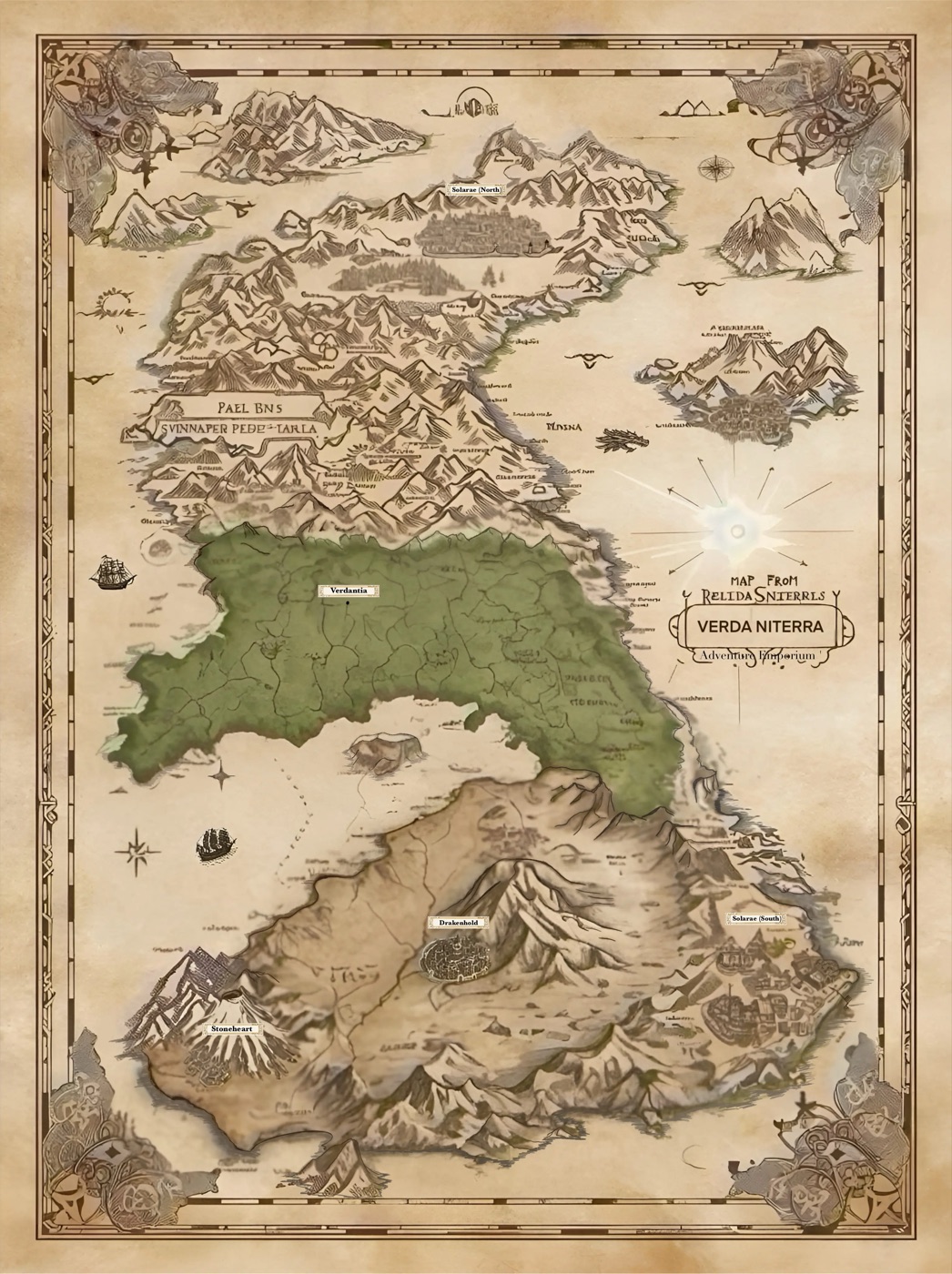
The first version was the source — the map that had been sitting on my hard drive for months. The artwork is gorgeous. The bones of the geography are right. But look at the labels: the title cartouche reads "MAP FROM RELIDA SNTERRLS / VERDA NITERRA." Other strings in the lower regions read "PAEL BNS / SVNNAPER PEDE TARLA" and "MELDA SNTERRLS." They look like real words at a glance. They aren't.
This is the first lesson of AI-generated cartography: the model is fluent at register but unreliable at naming. Parchment, line-art, atmospheric flourish — the model handles all of that effortlessly. But specific proper nouns, especially in invented languages, drift. They look authoritative. They are gibberish.
So I had a choice. Throw the map away and start over. Or keep the artwork and fix the text. I kept the artwork.
Version 2 — The First Fix (and the First Hallucination)
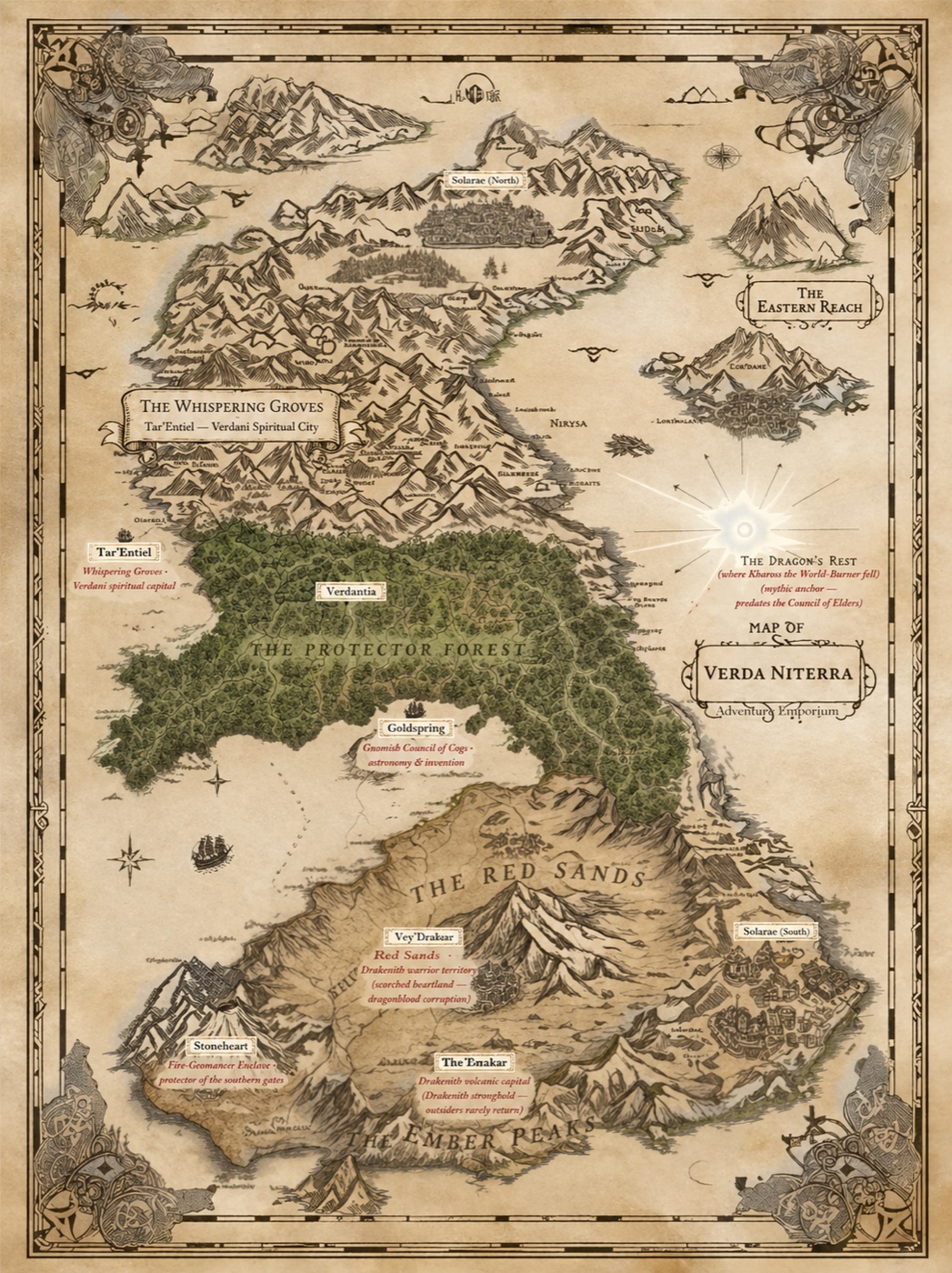
The first regeneration went well, mostly. The title cartouche fixed itself to "MAP OF VERDA NITERRA." A "Whispering Groves" banner appeared correctly above the spiritual city of Tar'Entiel. Regional zone labels — The Protector Forest, The Red Sands, The Ember Peaks — landed cleanly in red italic.
But the model also did something unprompted: it invented a second Drakenith capital called "The Ernakar."
The Ernakar does not exist. There is one Drakenith capital, and its name is Ash'Khaross, built on the bones of Khaross the World-Burner — the last dragon god. The model knew the geography needed a Drakenith capital. It did not know the canonical name. It filled the gap with a plausible-sounding fabrication.
It also added a Stoneheart sub-caption I hadn't asked for. Stacked duplicate labels on a mythic anchor. And mislabeled the Verdani forest as "The Protector Forest" — which is the name of a different forest on a different continent.
This is the second lesson: even within a "correction" prompt, the model will fabricate new content if the prompt is not atomic. Saying "fix the labels" is too broad. The model fills perceived gaps with plausibility. Each fix has to be one fix.
Version 3 — Atomic Corrections
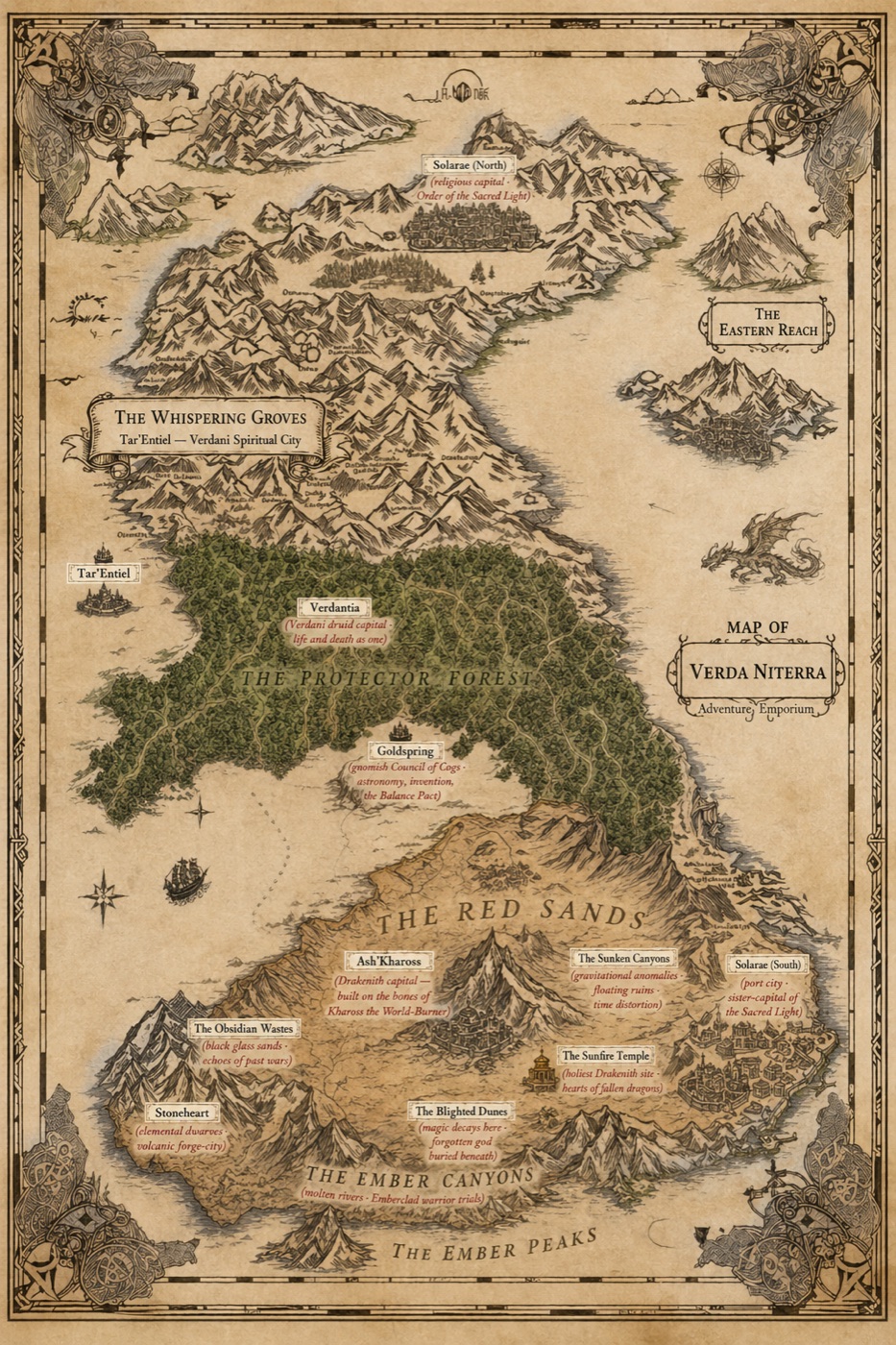
The third version was the first time I gave the model an atomic fix list — a numbered set of single, precise instructions, each addressing exactly one item, with no extrapolation:
- Delete "The Ernakar."
- Delete the Stoneheart Fire-Geomancer sub-caption.
- Resolve the Tar'Entiel duplication.
- Rename Ash'Khaross with the canonical sub-caption: (Drakenith capital — built on the bones of Khaross the World-Burner).
- Add Sunken Canyons / Obsidian Wastes / Blighted Dunes as proper forbidden zones.
- Introduce the Sunfire Temple.
- Remove the eastern Dragon's Rest hallucination — Khaross's grave is Ash'Khaross.
The model followed the list. Almost all of those fixes landed. But Goldspring — the gnomish Council of Cogs — was still in the wrong quadrant, and the Verdani forest was still mislabeled "Protector Forest" because I hadn't included those in the atomic list. Atomic discipline only fixes what you list. What you don't list, you accept.
Version 4 — The Great Forest and the Dragon Skeleton
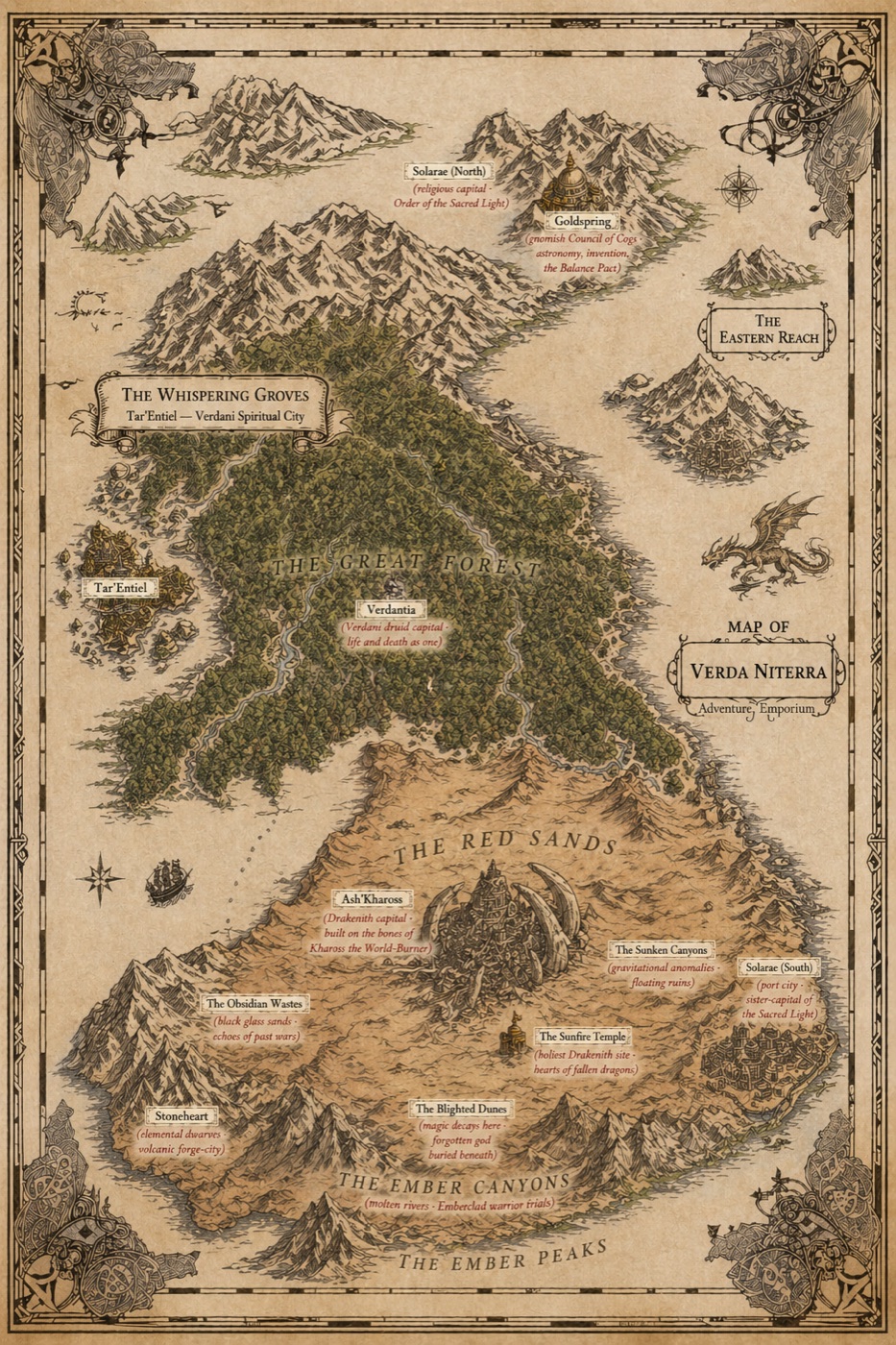
Version four delivered two of the most important visual canon moments in the saga.
First, the Verdani forest was finally renamed from "The Protector Forest" (which belongs to Eldvaria, an entirely different continent) to The Great Forest — matching canon's generic descriptor across all the docs.
Second, and more importantly: Ash'Khaross was rendered as the dragon-skeleton fortress it actually is. The city is canonically built into and upon the bones of Khaross the World-Burner. The new illustration shows an obsidian-and-bone fortress with rib-cage architecture rising from the desert. This is one of those moments where worldbuilding stops being descriptive and starts being visceral. Ash'Khaross is the dragon. Every wall is reliquary. Every corridor is shrine.
But Goldspring was still misplaced — now too far north, above the forest instead of in the Eastern Reach mountains. And Solarae North had lost its city illustration entirely when Goldspring's dome got accidentally placed in its slot.
I queued the next iteration for the next day.
Versions 5, 6, 9, 10 — The False Finals
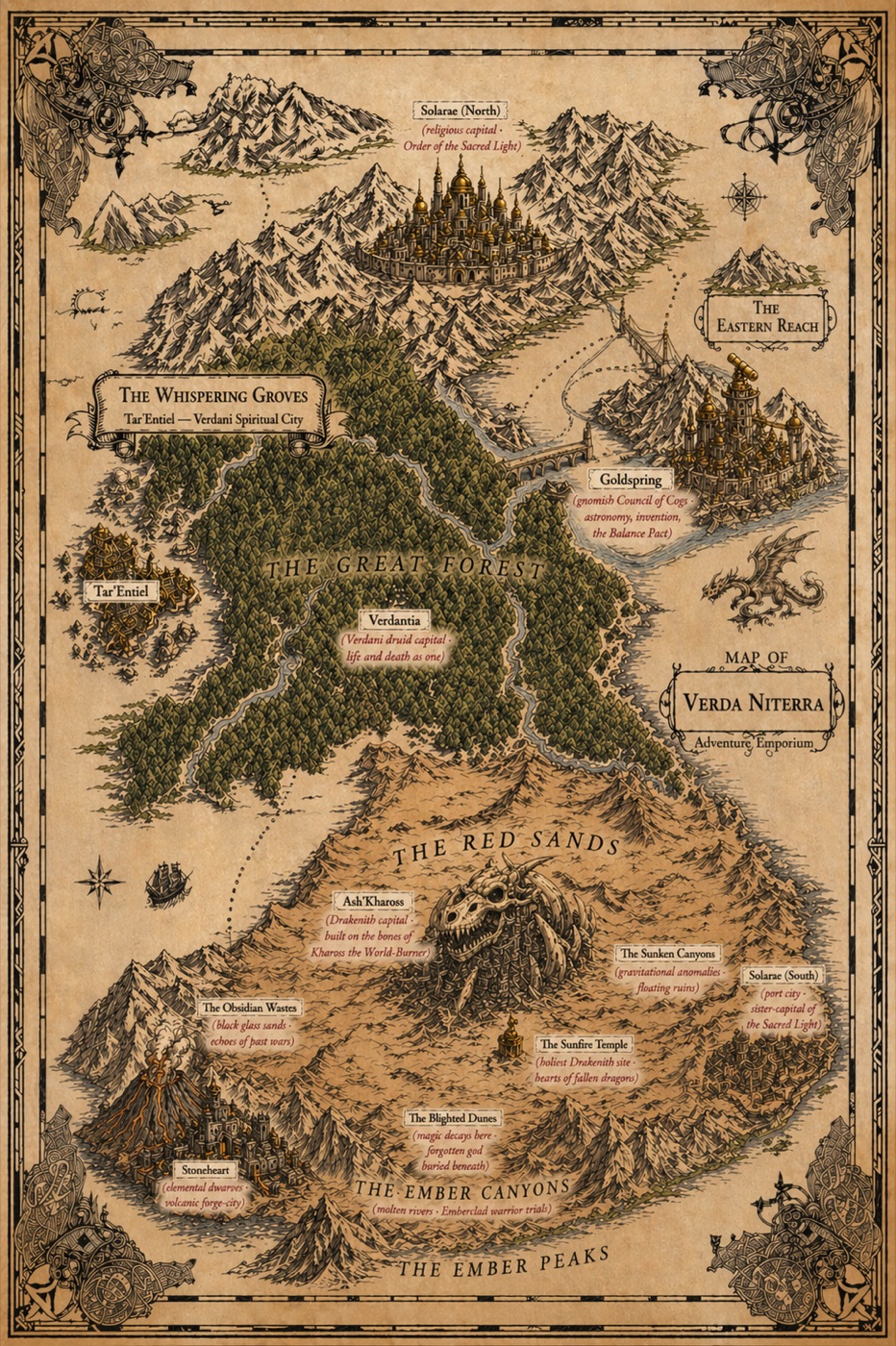
Then the iteration arc did something I didn't fully see at the time: it produced three different versions all confidently labeled "final."
Version 5 was named 05-canon-locked-final.png. It fixed Goldspring's placement. It was real progress. I called it final. It wasn't.
Version 9 and version 10 were both named 06-canon-locked-v9.png and 06-canon-locked-v10-final.png. Each one fixed something. Each one had something else still wrong on careful audit — label spacing, sub-caption phrasing, an ornamental flourish that wasn't quite consistent with the rest of the frame. None of them shipped.
I have kept all three of those filenames in the canon archive. I deliberately didn't rename them. They are evidence of a methodology blind spot I needed to see clearly: calling a draft "final" before it ships does not make it final. The willingness to put the word "final" in a filename three iterations before the actual deploy is the same cognitive bias that produces "the AI sounds confident, so it must be right." It's a confidence label applied to incomplete work. It feels productive. It is, until the next audit.
The lesson: canon-lock is not a state you declare. It is the version that survives the audit and ships to production. Anything before that is a draft, no matter what the filename says.
Version 7 — The One That Shipped
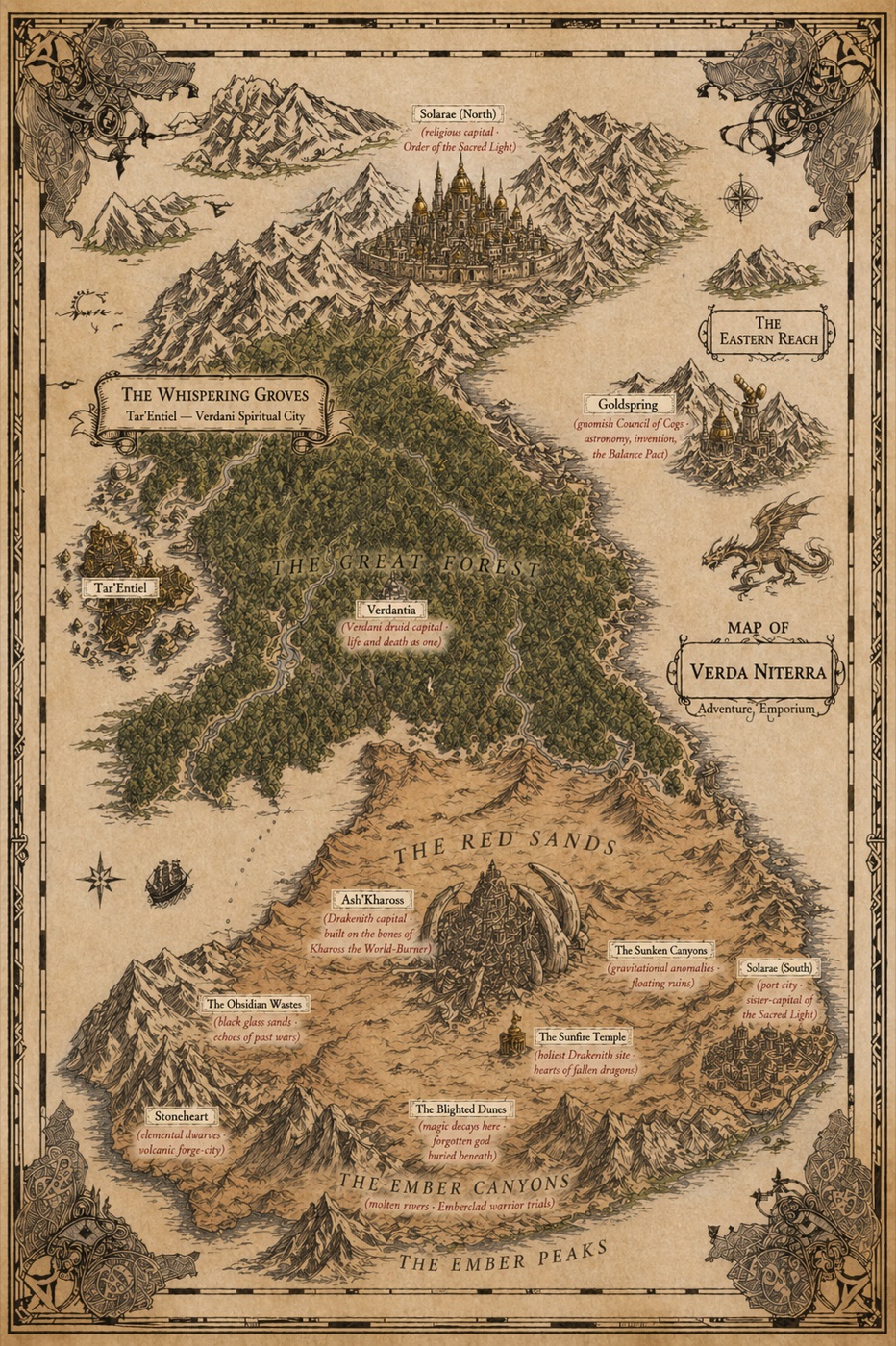
Version 7 cleared the audit and deployed. Every canonical placement is honored:
- Solarae (North) — religious capital, golden domes catching the sun in the high inland mountains
- Solarae (South) — port city, sister-capital, on the southeastern coast
- Goldspring — finally placed in the Eastern Reach mountains east of Solarae North, the gnomish Council of Cogs in their proper home
- Tar'Entiel — the Verdani spiritual city at the western edge of the Great Forest, beneath the Whispering Groves banner
- Verdantia — Verdani druid capital, life and death as one, central in the Great Forest
- The Great Forest — correctly named (no longer borrowing Eldvaria's "Protector Forest")
- Ash'Khaross — rendered as the dragon-skeleton fortress, the bones of Khaross the World-Burner made architecture
- The Sunfire Temple — holiest Drakenith site, hearts of fallen dragons, surrounded by the Red Sands
- The Sunken Canyons, Obsidian Wastes, Blighted Dunes, Ember Canyons — all forbidden zones in their proper places
- Stoneheart — elemental dwarves, volcanic forge-city, in the western mountains
- The Ember Peaks — the southern volcanic range that closes the continent
This is the version live at theetherealweb.com/world/realms/verda-niterra. Canon-lock is no longer aspirational. It is observable.
What This Method Is
This iteration arc is a working example of what I've been calling the Dense-Text Image Canon Method. The principles, drawn from seven versions:
The model is fluent at register — parchment, line-art, atmospheric flourish, the gravitas of an encyclopedia. It is unreliable at naming. It produces the authority of canon without the truth of canon. The seven versions are evidence: every iteration was visually convincing at the moment of generation. Six of them were wrong on closer inspection.
Canon discipline must be human. The model can produce the layout, the typography, the atmosphere, the implication of authoritative knowledge. It cannot determine whether the Verdani forest is The Great Forest or The Protector Forest. It cannot know that Ash'Khaross is built on a dragon's bones. It cannot tell you that The Ernakar doesn't exist. Only the author can.
What's Next
This is Creative Use Case #4. Numbers one through three were:
- Building a single character end-to-end in a day (Amaran Tharyn)
- The visual pipeline — portraits, turnaround sheets, deployment
- Catching an attention hook on the Tenebralis map
This one is the discipline behind the discipline: what it actually takes to bring a single AI-generated image into canonical truth. Seven iterations. One named methodology. Three "false finals." One real one.
Verda Niterra is now canon. Six other continents wait their turn — Tenebralis is partly there, Caelnyxia is in flight, CoralKeep just opened, Eldvaria and Varnoth and Piratea are queued. Each will go through its own iteration arc. None of them will ship before they earn the word final.
The map is not the world. It is one form the world takes when it is ready to be seen. The discipline is what makes that form trustworthy.