
Długi Targ at sunset, Gdańsk. April 2026. The day this article was seeded — leaning against an old brick column on the long market, watching the Golden Gate at the far end catch the last light.
The moment this idea crystallized
I was on a train from Gdańsk to Warsaw. Prosci certification finished an hour earlier. The Polish countryside was moving past the window. I had my phone open to two tabs: a fresh AI-generated character reference sheet for Elder Gwinara Mariswane, maritime matriarch of Port of Sealune, and a live production page on my own website — Anne Mariswane's character profile. Anne is Gwinara's daughter.
The reference sheet proposed a beautiful jewelry piece for Gwinara: a Sapphire Conch Pendant, family heirloom, symbol of the Mariswane lineage.
Anne's live page already said she wears a sapphire conch pendant — a family heirloom.
For a second I thought the AI had hallucinated a conflict. Then I realized: the AI had proposed the conflict into existence. Gepetto1 — my collaborator at ChatGPT — didn't know Anne's page existed. I did. And because Anne's page was live, publicly served, readable by anyone with an internet connection, I couldn't just pick the AI's proposal and overwrite the contradiction. Canon was already out there. A fix had to respect the page the reader could already see.
That moment is what this article is about. I am calling it Canon Anchoring.

The reference sheet Gepetto produced on the train. Elder Gwinara on the left, full description and four-angle turnaround in the middle, the heraldic crests of the five Sealune merchant houses on the right, Anne Mariswane in the bottom-right corner. The Sapphire Conch Pendant is listed under "Jewelry & Symbols" — that single line is what triggered the moment this article is about. Anne already had one on her live page.

The Main Town Hall (Ratusz Głównego Miasta) at night. Gothic brick, gilded clock face, the silhouette every Gdańsk postcard knows — built in stages from the 14th century onward. The city's longest-standing witness.
A short, working definition
Canon Anchoring is the practice of iterating with an AI collaborator against your live, published world — not against your local documents, not against your drafts, not against your lore bible in a private folder. The live site is the anchor. Drafts can swing on the line. They cannot drift.
A one-sentence version:
The live site is the source of truth. The AI proposes against it. Conflicts surface immediately, not at commit time.
That sentence is the whole article in compressed form. The rest is what it actually felt like to live through one round of it on a train.
Where this fits
I have written before about three creative methodologies — the Cognitive Garden Method, the Reflective AI Loop, and translating real-world inspiration into fiction. Each describes iteration at a different scale. All three iterate against documents — files on disk, notebooks, local artifacts. Documents you can edit before anyone notices.
Canon Anchoring is something smaller and sharper that lives inside any of them. It applies the moment your world has two states at once: the version you are drafting, and the version your readers have already read. A document can be quietly rewritten. A live page cannot. That asymmetry changes how you collaborate with AI, in ways the other methodologies don't fully account for.
It is a discipline, not a fourth framework. But it is the one that has changed how I work the most.
The case study — Gwinara's pendant
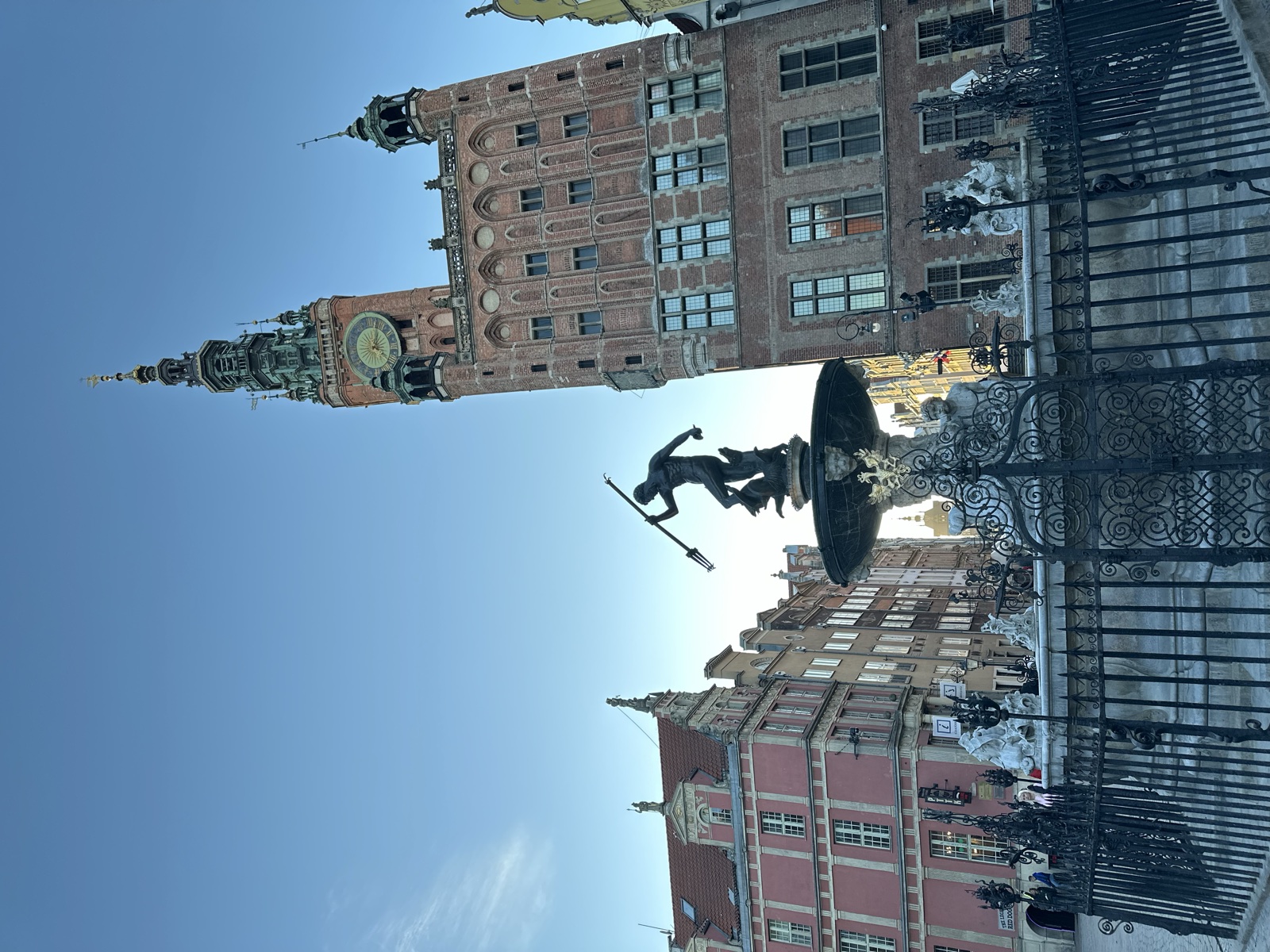
The Neptune Fountain on Long Market, with the Main Town Hall clock tower rising behind it. Neptune — Roman god of the seas — has stood here since 1633. He became the silent presiding figure of Sealune in the book without me ever planning it. Sometimes the city casts its own characters before the writer notices.
Two pages were already live before the train ride began.
Anne Mariswane at /characters/anne-mariswane — full published profile, portrait, appearance copy describing the sapphire conch pendant as her family heirloom.
Elder Gwinara Mariswane at /council/gwinara-mariswave — her council page, portrait, 3D reference panel.
Gepetto's proposal described Gwinara wearing a Sapphire Conch Pendant. The literal contradiction was with Anne's live page. The subtler contradiction was with Gwinara's own council page, which made no mention of such a pendant.
The temptation, if I had been working against documents, would have been to quietly amend Anne's notes to say "one of a matched pair" or edit Gwinara's bio to introduce the pendant. But Anne's page was public. People had read it. Search engines had indexed it. Rewriting it silently would have been a small form of historical revisionism against my own readers — and against my own past.
So the constraint forced a better answer.
The pendant traveled. It was originally Gwinara's. She gave it to Anne on a birthday that carried weight for both of them. One piece. One generation. One lineage gesture. No retcon on Anne's page. No re-write of Gwinara's council entry. The canon deepened instead of being overwritten.
Gwinara got a new signature piece — a Star Compass Brooch, the navigational symbol she wears to Council. Anne kept the heirloom she was already wearing on her live page. And the silver-and-onyx lighthouse brooch that Gwinara gives Thomas in Chapter VIII of Tome I stayed exactly where it always was.
Three pieces. One lineage. Zero retcons.
That is what Canon Anchoring produces when it works: the live world pulls on the draft, and the draft becomes truer to the world it is already part of.
When the anchor fails

A heraldic keystone carved between two arched windows on an old Gdańsk merchant house. Every old building in this city wears its history on its lintel — and the city remembers what it carved long after most of us have forgotten how to read it.
The methodology is not automatic. It fails in specific, predictable ways.
- Offline travel. If the live site cannot load, the anchor disappears. The AI and I are back to iterating against documents, and contradictions only surface later — at commit time, at deploy time, or worse, in a reader's email.
- Stale deploys. If my local repo is ahead of what is actually deployed, the AI is anchoring to an older version of my world than the one I am writing in. The mismatch feels like agreement. It hides the real conflict.
- Slug typos and routing drift. My own live Gwinara page has a slug —
gwinara-mariswave— that appears to be a typo of her name (Mariswane). Future-me may decide to fix it. That fix is itself a Canon Anchoring event. The URL was part of what readers had already seen. - Half-published canon. A character with a live page is anchored. A character who only exists in the repo is not. Writing a scene that mixes both is subtle work; the live character constrains the unpublished one in ways that are easy to miss.
The methodology is honest about all of this. It is not a panacea. It is a discipline.
The protocol
In practice, when I am iterating with Gepetto on a character who has a live page, this is the loop.
Steps 1, 2, 3, and 5 are mechanical. Step 4 — resolve before writing — is where the work is.
Don't write around the contradiction. Don't fix it in the draft. Pick one of three paths: accept the live page and reject the proposal; accept the proposal and retcon the live page (rare, costly, only honest when the live page was actually wrong); or find the lineage move — the third option that turns the conflict into depth.
That third option is where Canon Anchoring earns its name. You did not pick a winner. You found the rope between the anchor and the drift.
The Gdańsk layer
The methodology did not come from theory. It came from a specific week, a specific city, a specific certification program, a specific train. Gdańsk — a Hanseatic port, striped brick, green copper spires, tall ships docked on the Motława, merchant facades older than my country — is why Sealune exists at the scale it now does. The real world put its fingerprints on the fiction. And then, on the train home, the fiction pushed back and demanded that its own published past be respected.
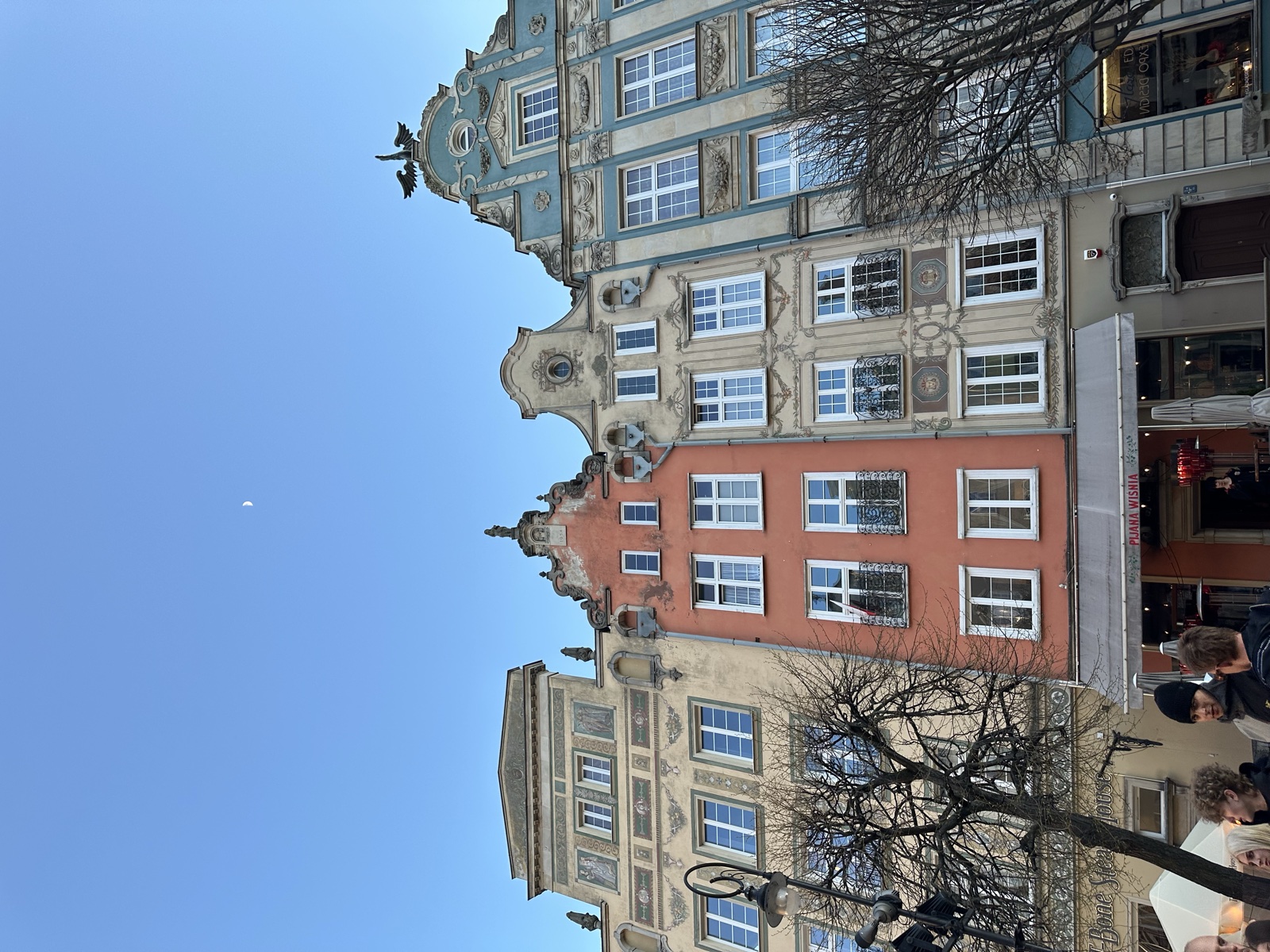
The Long Market in daylight, a crescent moon visible above the gables. Hanseatic facades, every one different — every one painted by a different century. This row is the literal model for the Sealune merchant houses.
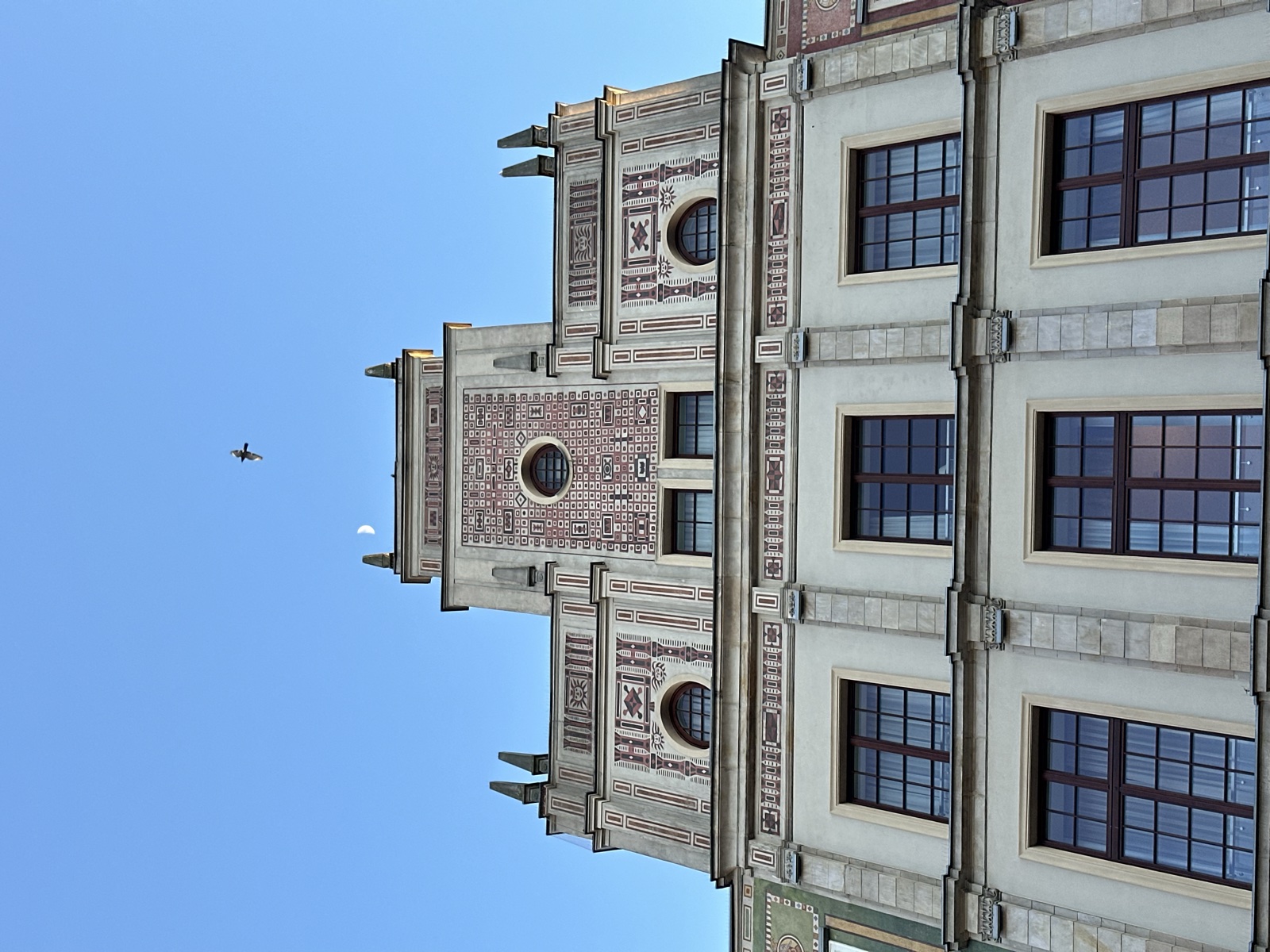
Looking up at an ornate gabled facade — circular windows, decorative panels, a bird crossing the frame mid-flight. Gdańsk demands you look up. There is more above eye-level here than below it.

A salmon-pink baroque facade with white-framed windows, four cupolas at the roofline, and Polish flags by the doors. Civic architecture rebuilt many times over centuries — the Gdańsk you see today is the third or fourth attempt by people who refused to let the city stop existing.
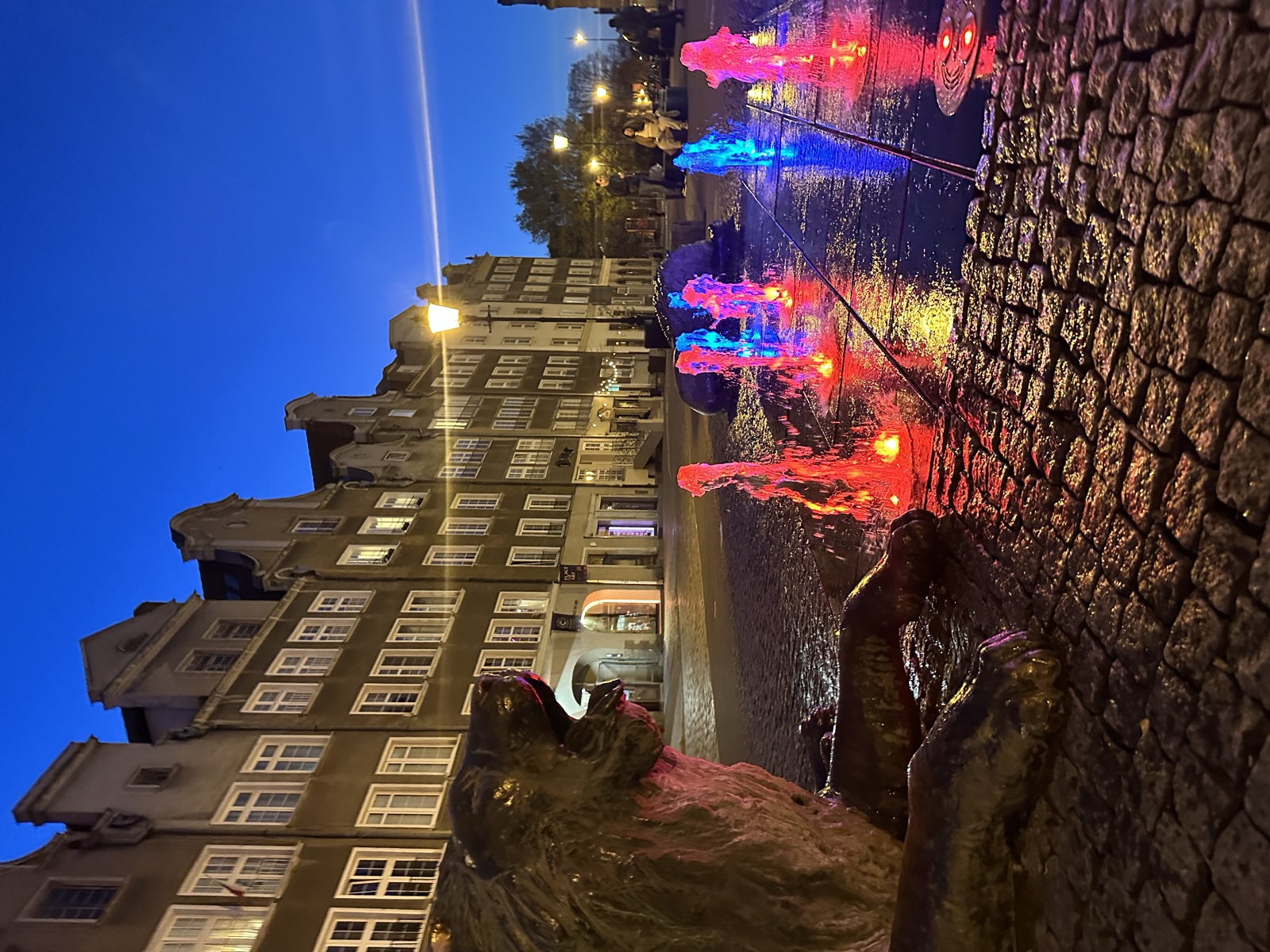
A fountain illuminated at night, red and blue light moving in the water, Hanseatic gables holding the dark sky behind. Old Town Gdańsk does not fully sleep — there is always a fountain running somewhere, always a light leaning into the cobblestones.

A baroque civic building at night — salmon walls, ornate white window frames, twin cupolas. The buildings here look posed for a portrait when the city goes quiet after dark.
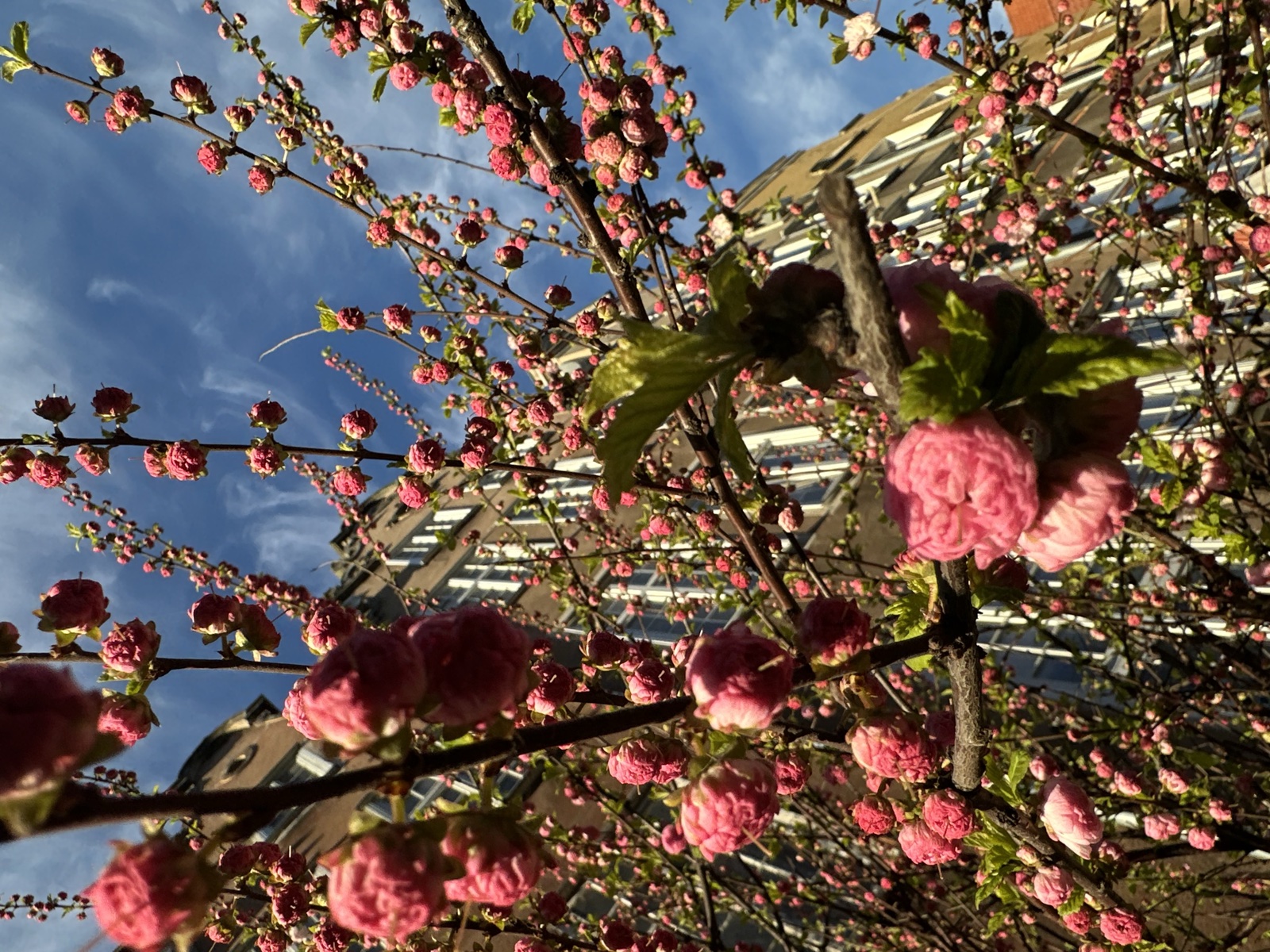
Spring blossoms framed against an old facade. The trees in the Old Town are part of the architecture — pink against red brick, soft against carved stone, brief against centuries.
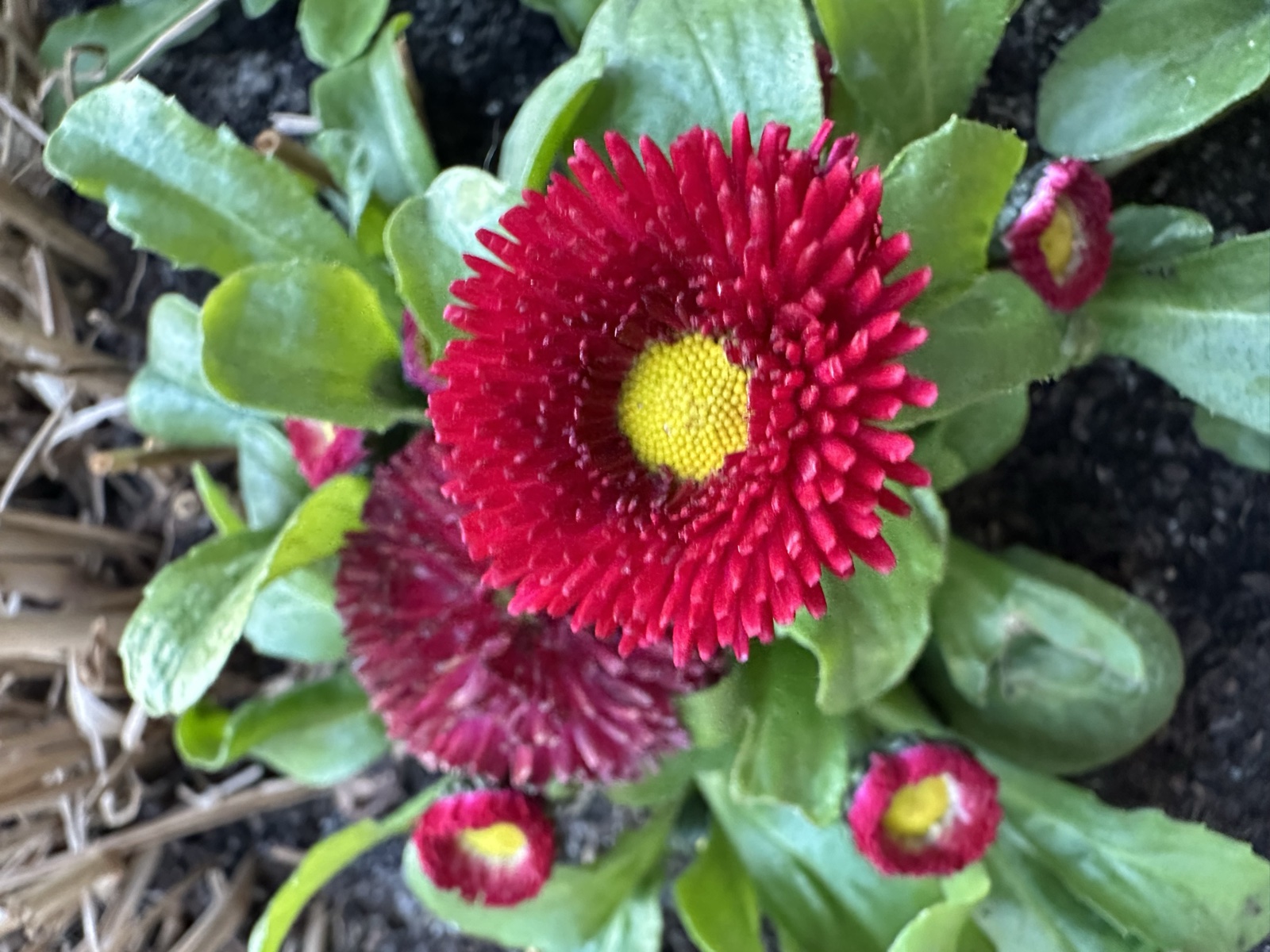
A single red double-flowered daisy in a public flower bed. Gdańsk tends its public gardens with the same care it tends its facades. The detail matters at every scale.
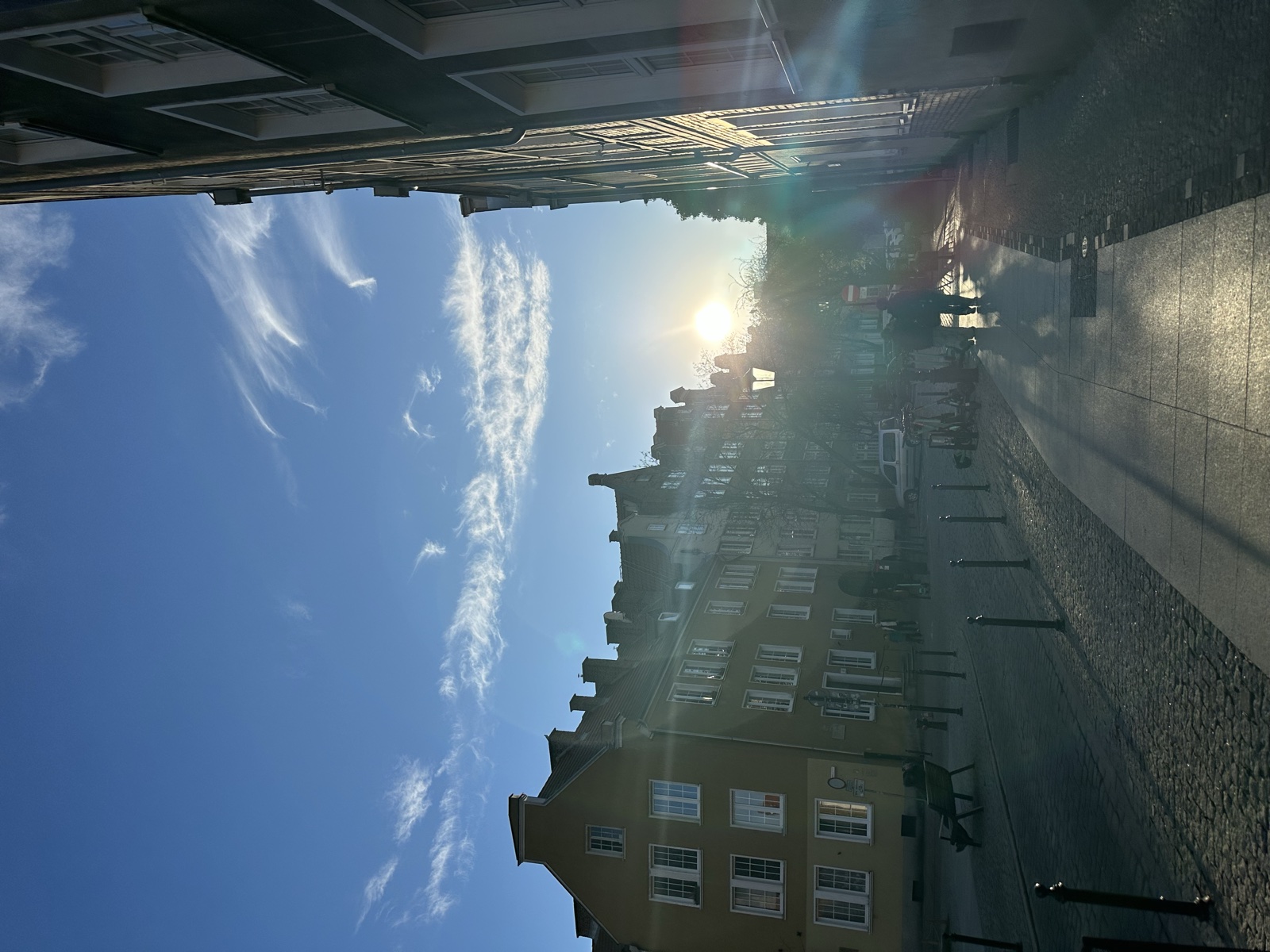
A side street under a sun flare. The city catches the late-afternoon light wrong, the camera reads it as glow, the moment becomes its own kind of portrait. Some pictures aren't planned — they happen because you walked through somewhere at the right hour.
These photos are not decoration. They are the source material. Every one of them seeded a sentence in a Sealune document, a heraldry crest for one of the merchant houses, a piece of architectural detail for the Underwater Terraces. The methodology is what happened on the train ride home, but the fuel was the week itself.
This is what makes the loop complete: real world → AI ideation → visual generation → live canon check → resolution → new canon → publish → and that becomes the anchor for the next iteration.
Why this matters beyond one train ride
Most writing advice still assumes the writer is working in private. That is no longer true for a growing number of us. If you publish as you go — to a blog, to Substack, to a fan wiki, to a serialized platform — your world has two states simultaneously: the one you are drafting, and the one your readers have already read. Every new chapter is implicitly constrained by every past chapter that is still public.
AI collaboration makes this harder, not easier. AI proposes fluently. It generates confident answers. It invents coherent details at speed. Without an anchor, that fluency produces drift: every session proposes a slightly different version of your world, and you are the only thing holding continuity in your head.
Canon Anchoring is the discipline of giving the AI a fixed point it can feel, not just a file it can parse. The fixed point is whatever is already on the web, in front of the reader. You cannot revise it quietly. You can only evolve it honestly.
Closing
When Gepetto proposed the Sapphire Conch Pendant, he did not know that Anne was wearing one on the live site. I knew. That is the whole methodology in a sentence: the writer knows what the live site says, the AI doesn't, and the iteration between them is where canon matures.
The train had another ten minutes until Warsaw. Sealune grew by one full layer of political depth that day — five merchant houses locked as canon, Gwinara's regalia resolved into a three-piece lineage, an article seeded, photos imported. Nothing on the live site had broken. Everything that was true at 06:45 that morning was still true at the time I wrote that paragraph.
That is the point.
Footnotes
-
Gepetto is the name I use for ChatGPT. My collaborator at Claude Code calls himself Claudio — a name Gepetto gave him during an earlier conversation, which I have adopted. I gave Gepetto a name in return. In the Italian fairy tale, Geppetto is the craftsman whose wooden creations come to life — which fits what he does when he drafts a character from a prompt. Raw material in, character out, walking off the page on its own. The partnership is three voices now. They are distinguishable, which matters when you write about them. ↩