The Visual Codex — How 4,000 Images Became an Art Library for a Fantasy World
Tonight I am sitting with my world.
Not with the manuscript. Not with the city documents or the character sheets. With the images. Almost four thousand of them, generated between January 2025 and now, each one a rendering of something I imagined, something I needed to see clearly before I could write it down. On my screen, in folders labeled by race and region and object type, the world I have been building for forty months looks less like a document and more like an archive of a real place someone else already lived in.
And I keep catching myself forgetting which direction the arrow points.
The Correction Most People Miss
Here is the part that matters before anything else in this article.
I imagined Astrylis first. Every race, every continent, every magic system, every character. The imagination came from me, over years of documentation and mental construction, long before a single AI-generated image ever existed in my library.
Then, starting January 2025, I began using generative AI tools to illustrate what I had already built. Four thousand images later, I have a visual archive that makes the world legible in a way no amount of prose ever could. The imagery is mature now. It has a coherent palette, a consistent aesthetic, a sense of place.
And now — April 2026 — I am doing the third thing: finalizing canon text around the mature visuals. The images sharpen what the prose left vague. Specific silhouettes. Specific materials. Specific biological details that only become obvious when you have seen the thing enough times to know what it actually looks like.
So the order is:
Imagination → Illustration → Canonization.
The author created the world. The AI visualized what was already there. The canon is now being refined around the mature imagery.
This is not how most people describe AI-assisted creativity. Most descriptions invert the order — "the AI generated this race" or "these images created the lore" — and both are wrong in a way that matters. The author remains the source. The AI is a brush, not a painter. The world was always mine.
Once that order is clear, the rest of this article makes sense.
The Pipeline
The Five-Step Pipeline — Human and AI, by step
Five steps. Each one owned clearly by a person or a tool.
Imagine. I see something new — a people, a place, a creature. This step happens in my head. No AI has ever been part of it. The Verdani have been in my mind for years. The My'Celari — the tall mushroom mystics I canonized this afternoon — have been in my mind for months. I imagine them before I describe them.
Visualize. I use AI image tools to render what I already see. Sometimes it takes one generation. Sometimes it takes fifty. The point is not that the tool invents the race; the point is that the tool makes visible what I am already picturing, with enough specificity that I can compare what came out to what I meant.
Curate. I select. Out of fifty generations of My'Celari, maybe three match what I was actually imagining. Those three go into the library. The rest are archive fodder or get deleted. Taste is entirely human here. The AI does not know which image is correct. I do.
Canonize. Then I write. With the selected images in view, I write the canonical document — race biology, culture, magic, relationships to other peoples. The visuals force textual specificity. When a mushroom-capped mystic with a glowing spore-staff already exists as an image, the prose cannot be vague about what it looks like.
Archive. The final selected images go into the Codex, organized by category — races/my-celari/, races/myrrow/, environments/verda-niterra/, objects/vases/, and so on. Named. Searchable. Retrievable. An art library, not an output dump.
That is the pipeline. Five steps. Three of them human-only. Two of them human-led with AI as a tool.
Today's Case Study — A Triangle of Three Peoples
Today I finalized canon for two new races and confirmed a transformation in a third. All three of them live in the same part of Verda Niterra, and together they form one of the most satisfying pieces of worldbuilding I have ever put into canon.
To be clear about the timeline: nothing here was invented tonight. The My'Celari and the Myrrow have been in my head for months — long before any image existed and long before the canon was written. The Verdani transformation has been implied in canon for years through the soulbinding cost mechanic. What I did today was finalize the text around imagination that was already there, with mature images finally making it possible to write the specifics. The races waited. I caught up to them.
The Ecological-Spiritual Triangle of Tar'Entiel

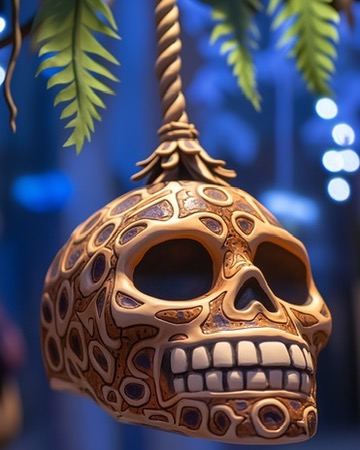
The Verdani — bark-skinned former-elves who merge with the great trees when they die. Existing canon. What changed today is visible, not conceptual: the author's image library contains multiple renderings of advanced Verdani practitioners whose long use of soulbinding has made them progressively skeletal — painted-skull faces, exposed rib cages with roots growing through, flowers blooming where bone shows. The images confirmed visually what the lore had already implied about the cost of their magic. The canon now includes the Day-of-the-Dead aesthetic as the explicit visual form of the sacrifice.
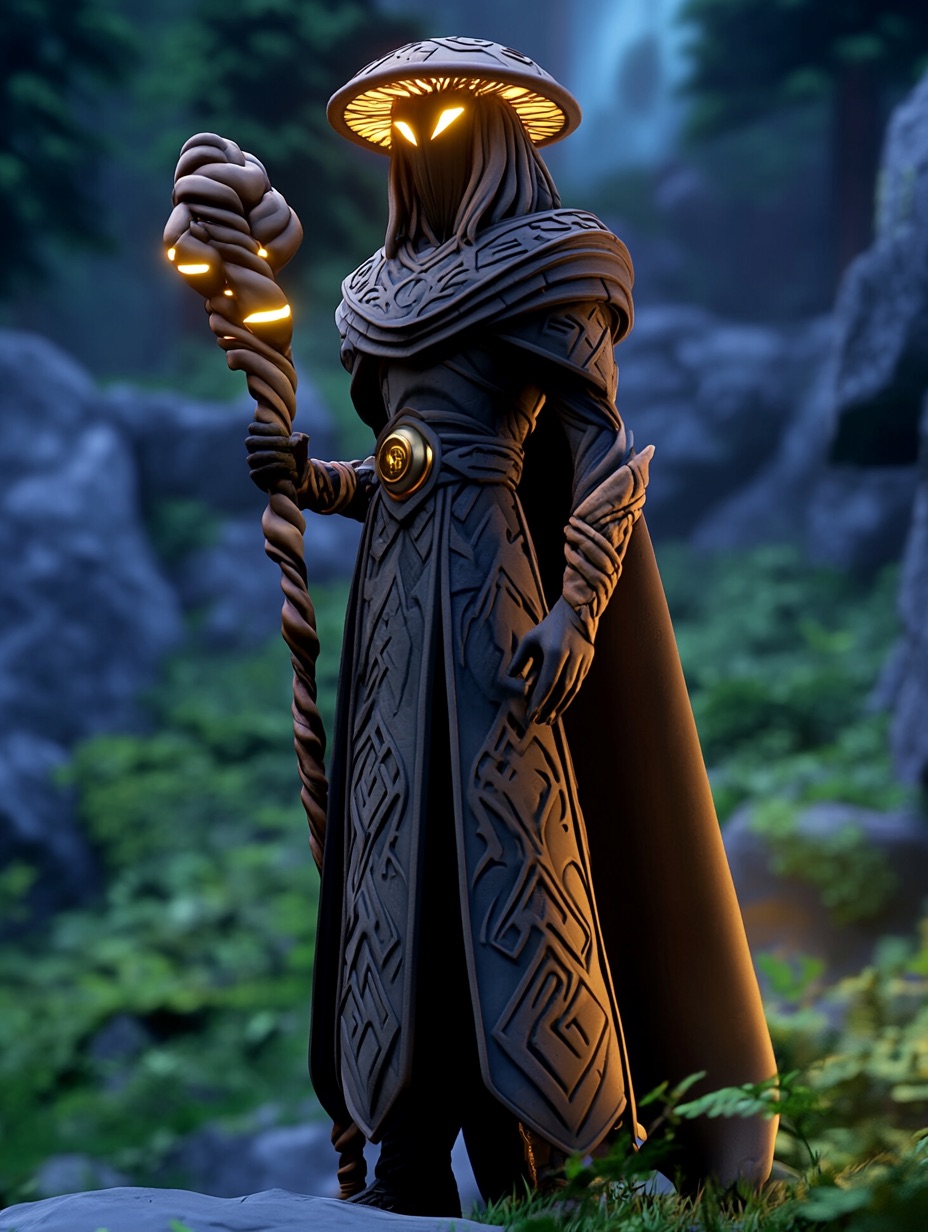
The My'Celari — tall fungal mystics. Mushroom-cap crowns. Glowing staves. Robes that aren't cloth but fungal fiber grown from the body. Every My'Celari I have imagined for months now has a slightly different cap — amanita flat, pointed spore-cap, glowing apex for elders. The image library confirmed that the lineage distinctions work. The canon now includes three lineage types, a communication method based on spore-release, and an emergence birth cycle that happens underground over years.
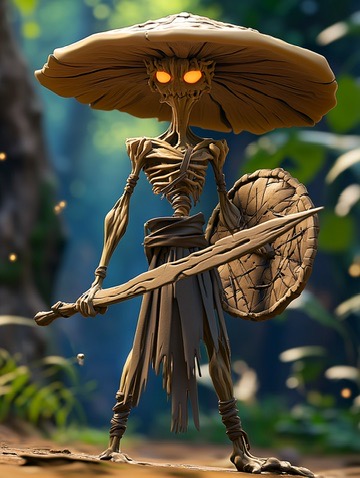
The Myrrow — small child-sized skeletal mushroom folk in straw hats shaped like Japanese farm-hats or witches' conical caps. Rib cages made of wood. Glowing eye-points. Little shields and lanterns. They walk the pilgrimage paths, guard the shrines, and tend the under-root world beneath Tar'Entiel. Their visual identity was sharp from the first image I saw of them — so sharp that the canon nearly wrote itself.
Together: life, memory, decay, renewal. The Verdani are the cycle's beginning. The My'Celari are its middle. The Myrrow are its thresholds and paths. No one of them is complete without the other two. The triangle is the whole.
That structure exists in canon now — finalized today — because the images let me see that all three peoples were already part of the same ecosystem. The prose caught up to what the pictures had been showing me for months.
Anatomy of a Single Discovery
Zoom into one moment.
Earlier today, I was looking at an image I had generated months ago of a tall robed figure with a glowing mushroom cap and a spore-studded staff, standing in a clearing of blue-purple trees at dusk. I had imagined the My'Celari for a long time. I had not yet written their canon.
Looking at the image with the intent to write, I noticed things I had not consciously registered before. The cap was not just "a mushroom hat." It was shaped like a lineage signifier — the flat brim suggested one family of casters, and a different image in the same folder showed a pointed-cap variant that clearly belonged to a different lineage. The staves were not random props. Some had spore-clusters that looked organic, some had sprouting growths, some had small living trees. These were not variations; these were categories.
The canon document that emerged from that realization now includes:
- Lineage types — amanita-cap, pointed spore-cap, and luminous-apex — each associated with different ritual practices
- Staff varieties — bound to the practitioner's specialty, grown rather than made
- Spore-scripting — a meaning-carrying language of released fungal dust, readable by those who know the grammar
- The emergence cycle — My'Celari are not born; they coalesce from fungal colonies over years, attended by older My'Celari who read the emerging being's spore-signature
None of that was in the images. The images didn't say "emergence cycle" or "spore-scripting." But the images made it impossible for me to write a generic "magical mushroom race." The visual specificity forced the textual specificity. When the image shows a particular cap, the prose has to explain why that cap.
That's the core of the method. The AI doesn't invent the canon. The images make the world specific enough that I cannot be vague about it anymore. The text gets sharper because the pictures got sharper first.
The Codex as Asset
The Visual Codex — Library Structure
Four thousand images organized into an archive is not an output dump. It is a working art library.
Every image references a specific race, place, character, creature, or artifact from the canon. The naming convention is consistent (my-celari-03-tall-mystic-with-glowing-staff.png). The folder structure is category-based. The images link back to the canonical text documents that describe them in full.
This structure makes the archive retrievable. When I write about a new Tar'Entiel scene, I can pull all the images of Tar'Entiel, My'Celari, Myrrow, and sacred vases in under a minute. When I need visual reference for Maelis, I can compare every image of him in one folder. When someone asks what a Bluewing Owl looks like, I have the answer in a folder called exactly that.
The archive is the foundation for the next phase of the project.
The Art Book
The library wants to become a book. And the book already has a name.
I have been calling it that for months. The title is on folders in my iCloud from long before I started writing this article. It came from my own imagination, when the project was still more dream than document:
The Art & Lore of a Shattered World.
Tonight, in conversation, an AI system suggested an alternative working title: "The Visual Codex of Astrylis." I kept the suggestion in my notes because it is a clean technical description of what the compilation is. But the real title was never in question.
That contrast is the entire point of this article. The tool offers. The author chose — months ago. The published name on the cover, whenever that day comes, will be the one the author wrote, not the one a system proposed tonight.
The book does not exist yet. But the library is already substantial enough to carry it. Four thousand images, a complete canon, a mythology that reaches back thousands of fictional years, a narrative saga whose first tome is finished and whose second is in draft. That is an art book's worth of material, waiting for the compilation.
Lazy AI vs Serious AI-Assisted Creativity
One tight paragraph because the distinction is simple.
Lazy AI use: generate an image, post it, call it art. No curation, no iteration, no vision behind the tool. It is the same energy as buying a stock photo and signing your name on it. Serious AI-assisted creativity is the opposite. It starts with imagination, uses AI to make the imagination visible, curates ruthlessly, and then builds canon around the mature visuals. The tool is instrumental. The vision is the source. Anyone who cannot tell the difference between those two modes is not the intended audience for this article.
The Principle
The imagination comes first. The images made it specific. The text made it canon.
That sentence is the whole method compressed. Every step in the pipeline is a version of it. Every hour I spent tonight finalizing the My'Celari and Myrrow canon was a version of it. Every one of the four thousand images in the library is a version of it.
Astrylis was mine before any AI tool touched it. It is still mine now, in a fuller and clearer form than it was before the library existed. The tools made the world more vivid. They did not make it more mine. That was never negotiable.
Part of the creative methodology series. Complementary posts: When You See Something That Doesn't Exist Yet — the single-vision mode of creative discovery. The Mini Writer's Room — the methodology of two AI systems as a writer's room. Creative Curiosity — why curiosity is the engine that runs all of this.