8:07 AM — Coffee, Sunlight, and a Feeling
It started the way most of my ideas start: I was making coffee.
The morning light was coming through the balcony window. I had bought petunias the night before — red and white striped ones — and they were sitting in their pots on the table, waiting to be planted. The apartment smelled like fresh soil and espresso.
I opened ChatGPT and started talking. Not typing — talking, through voice. I was describing a young man waking up in a fortress. A stone chamber. A narrow window overlooking a valley covered in dark pine forests and silver mist. A world that never sees real sunrise.
I didn't have a name for him yet. I didn't have a plot. I had an image: someone sitting by a window in a place he loves, thinking about every other place he has never seen.
That was the seed.
By the end of the day — 5:53 PM, hands dirty from planting those petunias — the character had a name, a backstory, a full origin story, a canonical profile, and a documented path into the main saga of The Ethereal Web.
This is how it happened.
The Two-AI Workflow
I work with two AI tools, and they serve completely different purposes.
ChatGPT is my creative conversation partner. I talk to it. Literally — through voice messages, while walking, while driving, while making coffee. It responds in a narrative style that matches the mood I bring to it. It proposes ideas, expands scenes, asks me questions that push the story further. It is excellent at catching a vibe and running with it.
Claude Code is my canonical memory. It holds the entire Astrylis project — 7 continents, 30+ cities, 40+ races, 15 main characters, deep mythology going back 40 months of worldbuilding. When I create something with ChatGPT, I bring it to Claude Code to validate, integrate, and store. Claude Code makes sure the new idea doesn't contradict something I wrote two years ago.
Neither tool replaces me. I am the author. I decide what's real and what isn't. But together, they let me move at a speed that would be impossible alone.
8:30 AM — The Character Takes Shape
In the first 30 minutes, ChatGPT and I built the emotional architecture of the character:
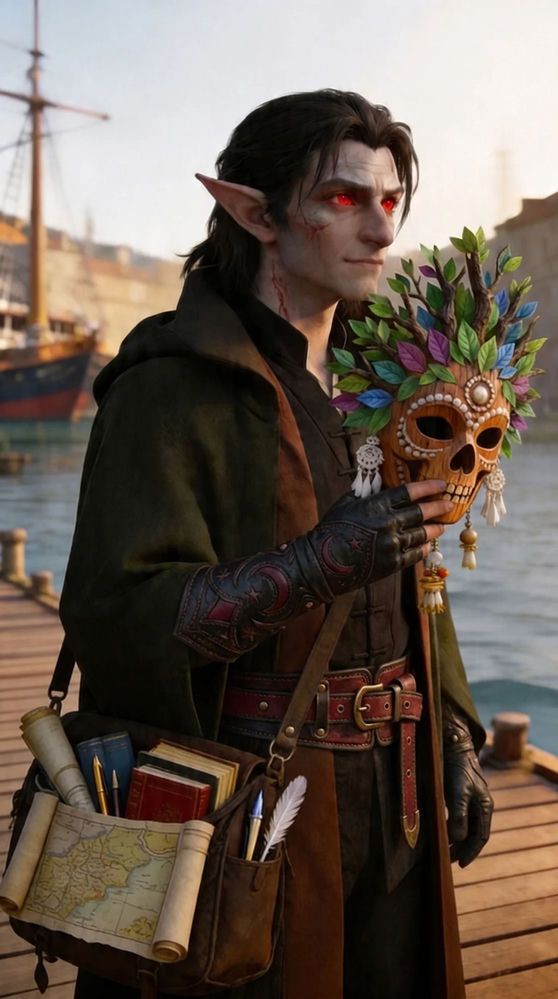
- He is a young Nocthyris — one of the most feared and misunderstood races in Astrylis. Practitioners of blood magic called Hemocraft, where every spell costs years of your life.
- He lives in Blood Moon Bastion, a hidden fortress carved into cliffs on the edge of Tenebralis, the continent of eternal twilight.
- He is scholarly, not martial. In a race of disciplined warriors and blood-sorcerers, he is the one reading maps in the library.
- He wants to leave. Not out of anger — out of curiosity. He loves his people. He also wants to see sunlight.
ChatGPT helped me build the political reality of why leaving is so difficult — the dwindling population, the external hostility from factions that hunt Nocthyris, the diplomatic constraints of living under Duskborn protection. Every layer made the character's desire more meaningful.
The Blood Moon Gathering
Then came the origin event.
I imagined a rare diplomatic dinner — held during a Blood Moon alignment, when master Hemocrafters produce a substance so rare it takes years off their lives to create it. The Council of Elders attends. Queen Xanthea of Mystaris. Pirate envoys from Piratea. Diplomats from every continent.
And during that dinner, the young Nocthyris meets Sylra — a Verdani woman wearing a carved wooden mask, who watches the room the way he watches the room.
She sees that he is different. Before she leaves, she gives him two things: a notebook full of maps and city sketches, and her ceremonial mask.
"Sometimes the world sees what it expects to see," she says. "A mask can give you the freedom to walk before people decide who you are."
I told all of this to ChatGPT in a voice message while standing in the kitchen. It helped me structure the scene, refine the political dynamics, and connect it to existing lore. Then I sent the whole package to Claude Code, which integrated it into the canonical timeline — one year before Thomas Kessler's arrival in Astrylis.
The Name
This is where it gets interesting.
ChatGPT proposed about twenty names. Four different stylistic directions. Lunar priesthood names. Traditional Nocthyris names. Names with subtle light-symbolism. Traveling aliases.
None of them were right.
I went to an online fantasy name generator — a simple tool, nothing sophisticated — and scrolled through random outputs until something caught. Amaran Tharyn. The moment I saw it, I knew. That was him.
And then I decided something else: when he arrives at Port of Sealune and the harbor clerk asks his name, he says "Robert."
Because he has always been quietly fascinated by the simplicity of human names. Where Nocthyris names carry the weight of a dying civilization, "Robert" carries nothing. And that freedom — the right to be no one in particular — is exactly what he is looking for.
AI didn't give me the name. It gave me everything around the name — the world, the culture, the weight that makes the name matter. But the name itself came from me scrolling through a list at 9 AM and trusting my gut.
That's how creativity works. The tools scaffold. The author decides.
The Escape
The Blue Comet crosses the skies of Astrylis about two months before Thomas arrives. On the third night, a massive creature from the deep Tenebralis forest — maddened by the comet's energy — smashes through the eastern cliff wall of Blood Moon Bastion.
During the chaos, Amaran puts on Sylra's mask, picks up his bag with the notebook and his coat, and walks through the breach in the wall.
Three days later he finds a pirate girl at a cove on the southern coast — someone he met briefly at the Blood Moon Gathering. She has a ship, a parrot, a dwarven flame-sword, and absolutely no fear of forbidden places. She smuggles him out of Tenebralis through routes the Duskborn patrols don't cover.
When the ship clears the twilight zone and he comes up on deck, he sees the sun for the first time in his life.
It doesn't burn him. It doesn't curse him. It's just warm.
The Origin Story Draft
By early afternoon, Claude Code had written a full narrative draft of Amaran's origin — seven scenes, from the Blood Moon dinner to the first morning at sea. I didn't write the prose myself this time. I described every scene, every beat, every emotional moment, and Claude Code shaped it into a continuous narrative that stays true to the world's established canon.
That's a different kind of creative partnership. I am still the architect. The scenes come from my imagination — the Blood Moon Gathering was mine, Sylra's mask was mine, the pirate girl was mine, "Robert" was mine. But the prose execution happened faster than I could have written it alone, and it was anchored in 40 months of accumulated worldbuilding data that no single human memory could hold.
5:53 PM — Petunias
Now it is almost six in the evening. I am on the balcony, planting the petunias I bought last night. Red and white striped. The soil is cool and dark and smells the way soil should smell.
This morning I woke up with a feeling about a character. By evening that character has:
Not because AI replaced my creativity. Because AI amplified it. I had the ideas. AI gave me the tools to build them into something real before the feeling faded.
That's the use case. Not "AI writes a book." Not "AI replaces the author."
AI helps the author move at the speed of imagination.
The petunias are in the soil now. The sun is going down. Somewhere in the world of Astrylis, a young man in a wooden mask is standing on the deck of a pirate ship, seeing that same sun for the first time.
His name is Robert.
And his story is just beginning.
The Afternoon — A Second Kind of Creation
The character was done by lunchtime. But the day wasn't.
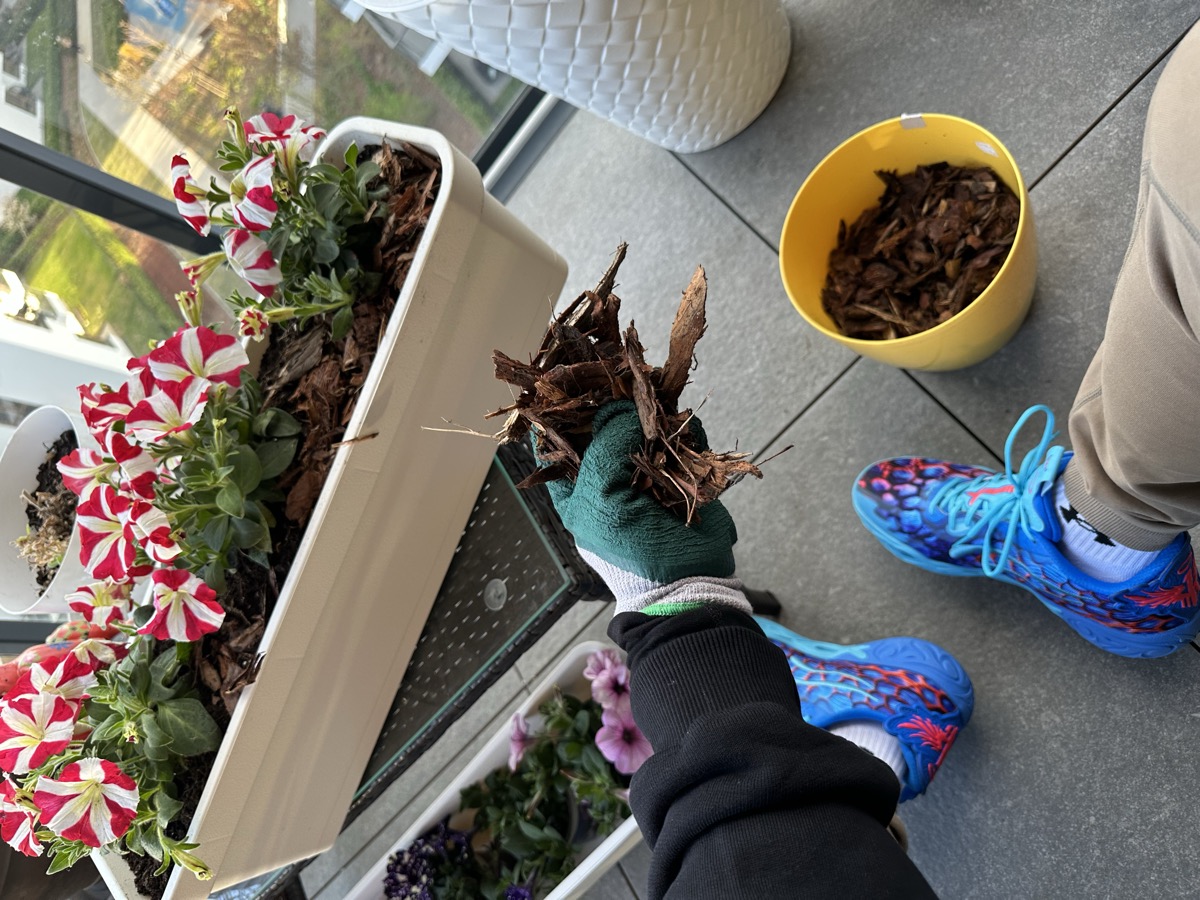
By mid-afternoon I was on the balcony planting petunias. Red and white striped ones. Pine bark mulch. Warm soil. The kind of work where your hands are busy and your brain is free.
And that's when the larger story started coming through.
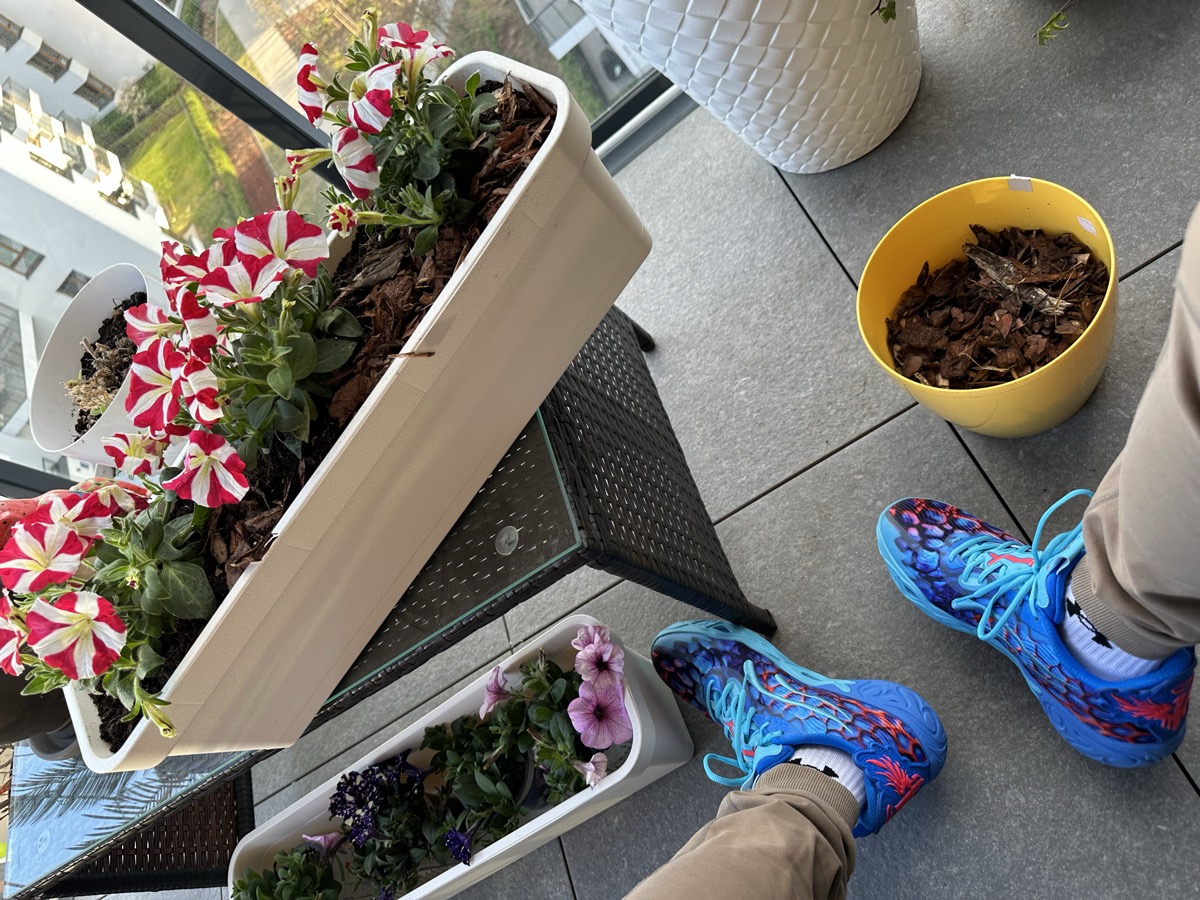
I opened ChatGPT again — voice mode, phone in my pocket — and started talking about Tome II. About where the saga is heading. About Merra, the Shadewalker who everyone in the story thinks is the villain but who is actually an anti-hero carrying the grief of an entire destroyed civilization. About Mystaris, the ancient Fae kingdom where all the threads converge. About a Blood Moon rising over the city on the night of the confrontation.
And then, standing there with pine mulch in my hands, I realized something about the Ivory Tower.
The tower where the Council of Elders meets. The tower where Kaelthir made her sacrifice thousands of years ago. The tower that everyone in Astrylis treats as symbolic architecture.
It isn't symbolic.
It is literally the horn of a dead god.
The name "Ivory Tower" isn't poetic. It's descriptive. The material is actual ivory — from the remains of a primordial creature that existed before the Shattering broke the world.
And that means Kaelthir didn't just perform a ritual in a building. She broadcast her sacrifice through the bones of an ancient being. She rang a bell made from a dead god, and the sound of it became the ward network that still protects the world.
Then the next thought: if the Ivory Tower is built from a primordial fossil, what about Dhul'Azhar? What about the Red Sands where the dragon god Khaross flew to die? What about the other ancient sites across Astrylis?
The world is built on the bones of dead gods.
And the civilizations living there don't fully understand what their foundations are made of.
That's the kind of realization that doesn't come at a desk. It comes when your hands are in soil and your mind is wandering, and an AI is listening and catching the pieces as they fall.
Two Use Cases, One Day
Looking back at this day, I can see two distinct kinds of AI-assisted creativity happening:
Both happened in one day. Both used AI differently. Both were mine.
Neither replaced me. Both amplified me.
6:15 PM — The Petunias Are In
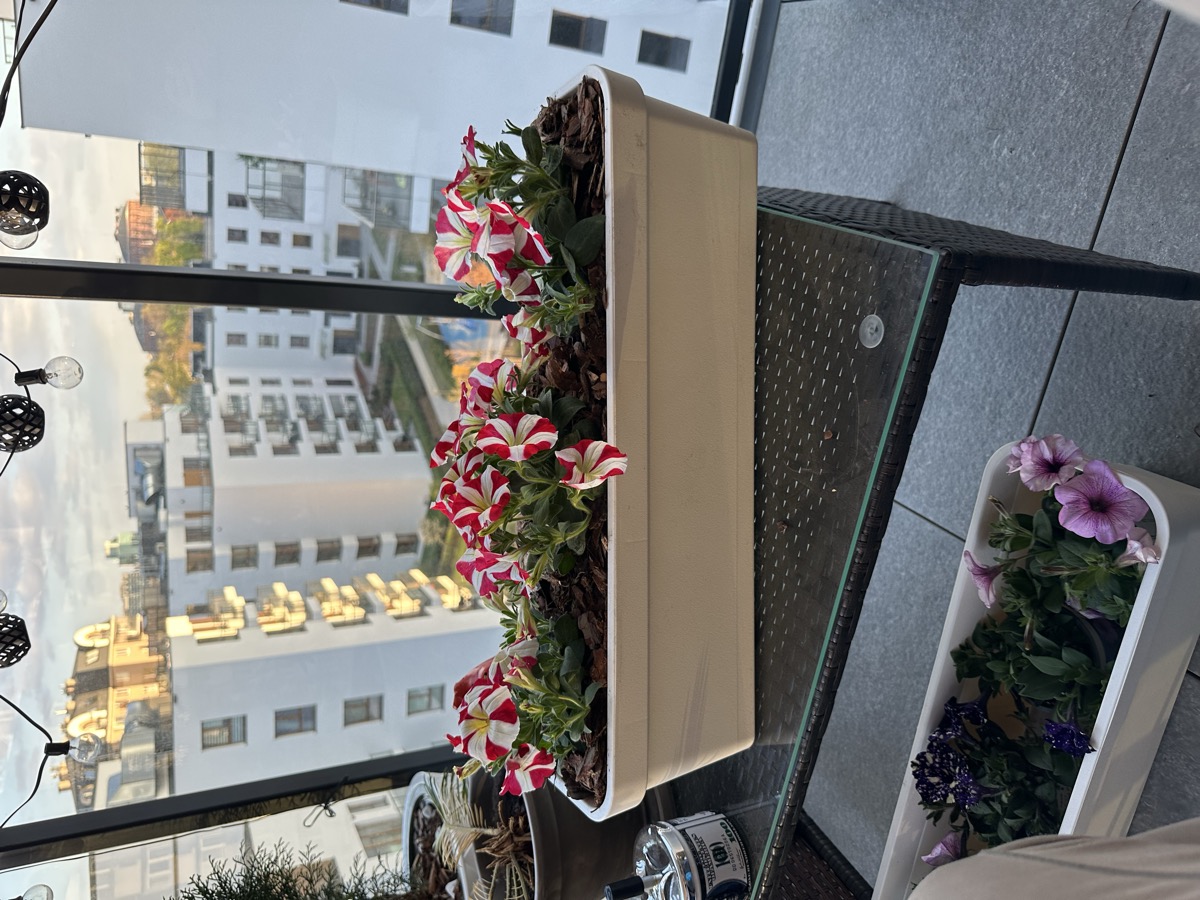
The flowers are in the soil. The pine mulch smells like forest. The sun is going down over the city and the balcony glows warm.
This morning I made coffee and imagined a young man waking up in a fortress he loved but needed to leave.
This afternoon I planted flowers and discovered that the world I've been building for three and a half years is built on the bones of dead gods.
Both of those things are real creative work.
And both of them happened because I let myself think out loud — to an AI that was listening, catching, and holding the threads — while my hands did something simple and alive.
That's not "AI writing a book."
That's a human building a world.
With tools that help him move at the speed of imagination.
And sometimes, with petunias.
The Ethereal Web is a tetralogy by George M. J. Zak. Tome I — Thomas the Azure Light — is in final preparation for release. Follow the journey at theetherealweb.com.