Characters Don't Arrive Alone
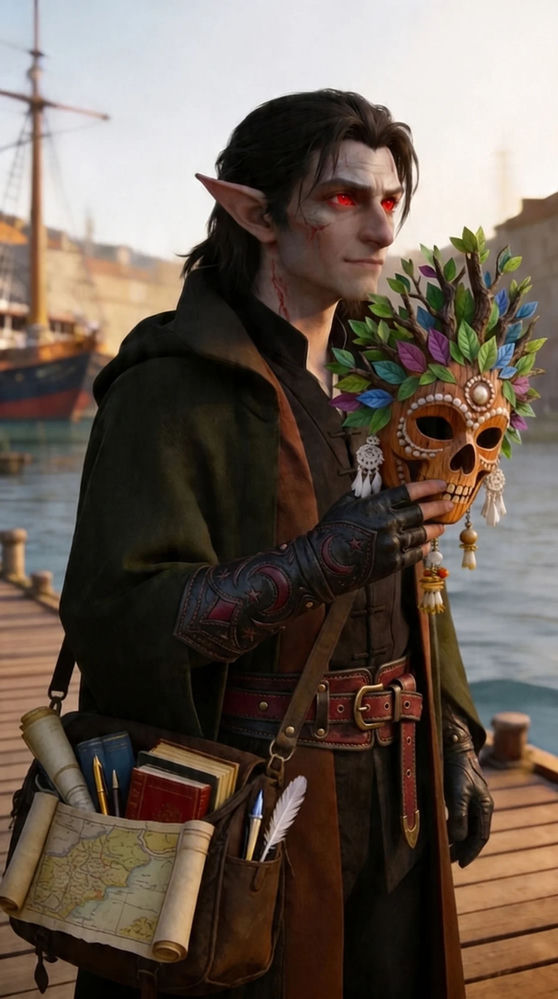
Yesterday I created a character named Amaran Tharyn — a young Nocthyris scholar who escaped a fortress in a twilight continent to see the sun for the first time in his life.
By the end of that day he had a name, an origin story, and a canonical place in the saga.
But something was missing.
He escaped alone. He reached a cove on the coast of Tenebralis. And there — in the story — someone was waiting with a ship.
Who?
I didn't know yet. I just knew: characters don't arrive alone. They bring their people with them.
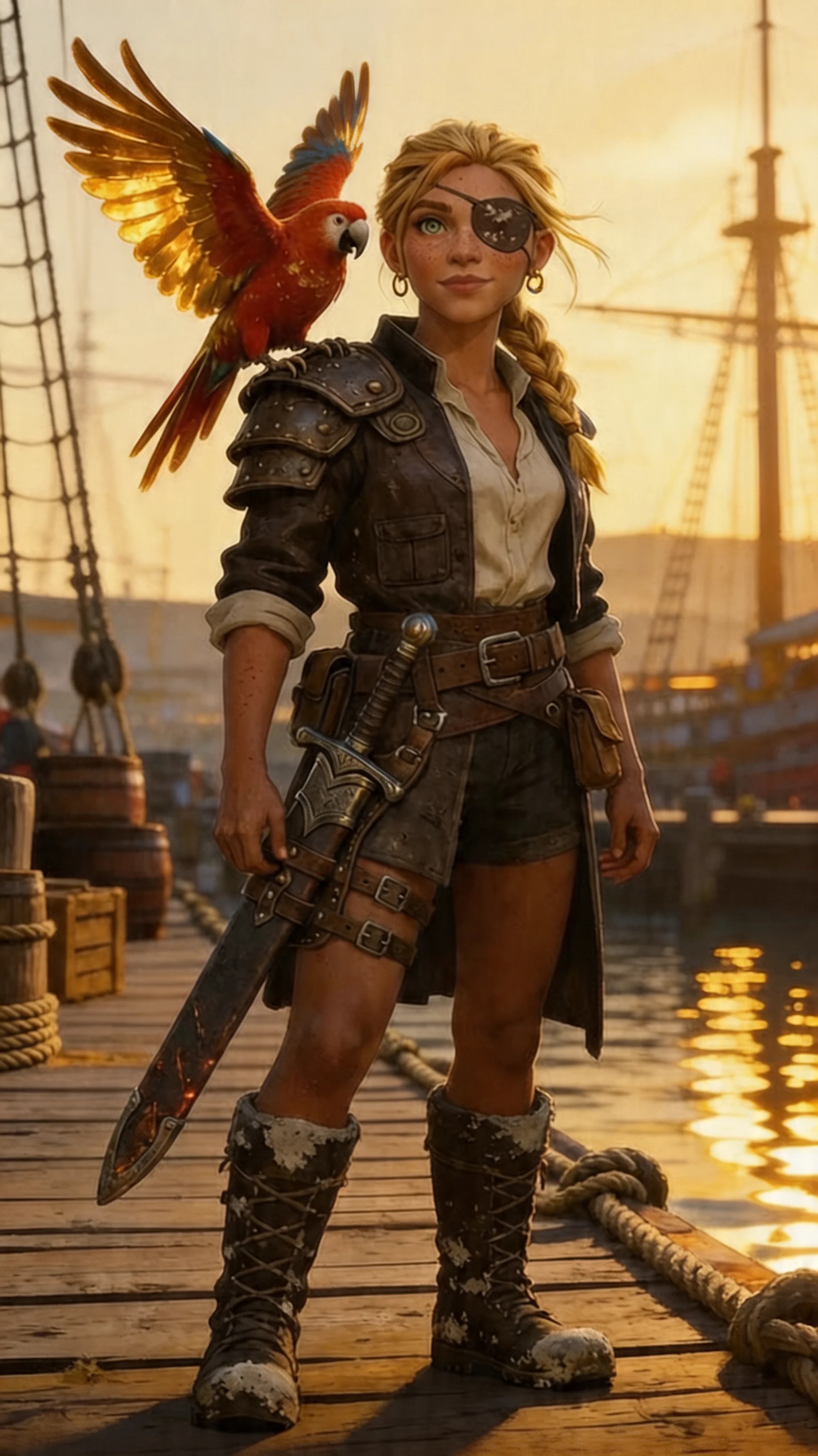
Today that person got a name, a face, a sword, and a parrot.
The Pirate Who Was Always Curious
Her name is Izabelle Dubuaz.
She is a human pirate from the Islands of Piratea — the chaotic, decentralized maritime region where pirate captains act as their own governments and the only law is the one you can enforce from the deck of your own ship.
But she's not a villain. She's not a rogue archetype. She's an explorer who happens to carry a sword.
Her defining trait is curiosity. Most sailors stay on the charted routes. Izabelle sails toward the things that aren't on the maps.
That curiosity is what brought her near Blood Moon Bastion — the Nocthyris fortress — during a diplomatic gathering. While the diplomats negotiated, Izabelle was studying the fortress walls and wondering what kind of people lived inside.
Three months later, when a masked figure stumbled out of the forest at a hidden cove, Izabelle recognized what she was looking at: a Nocthyris, outside the Bastion, alone, running.
She said: "I was wondering when one of you would actually do it."
And she offered him a place on her ship.
Adapting a Name to the World
Here's something interesting about the creative process.
I originally chose "Dubois" as her family name — a name I've always loved. But then I realized: there's no France in Astrylis. No French language. No Earth reference should exist in a fantasy world's naming.
So I adapted it.
Dubois became Dubuaz.
Same sound. Same feeling. But now it belongs to the old maritime tongue of Port of Sealune — a Varnoth trading port where the Dubuaz family has been running ships for generations. "Dubuaz" translates roughly to "of the woods" in the old port dialect, which is ironic for a family that hasn't spent more than a week on land in living memory.
This is a small detail, but it matters: when you build a world, every name has to feel like it grew there. AI can help you scaffold the culture, but the moment you hear something that doesn't belong, you fix it. The author's ear is the final filter.
The Parrot Named Rouge
Every pirate needs a parrot.
But in Astrylis, parrots are not just pets.
Rouge is a large red-and-gold bird with feathers that have a metallic golden sheen — dense, layered plumage that can deflect sword strikes and arrows. When struck, the feathers ring faintly like thin metal. Rouge is functionally armored by its own body.
It sits on Izabelle's left shoulder on a leather perch sewn into her coat. It screams insults at customs officials. It has started at least one dock fight by yelling something terrible at exactly the wrong person.
But here's the deeper layer: Rouge might be intelligent.
Not just mimicking words — actually understanding them. Sometimes it says things at exactly the right moment. Sometimes it coordinates with Izabelle in combat in ways that suggest rehearsed tactics, not instinct. Sometimes it looks at someone with an expression that is too knowing to be animal.
The story leaves this open. The reader starts by laughing at the parrot. Eventually they start wondering about it. That slow shift — from comic relief to genuine mystery — is one of the most satisfying narrative tricks in fantasy.
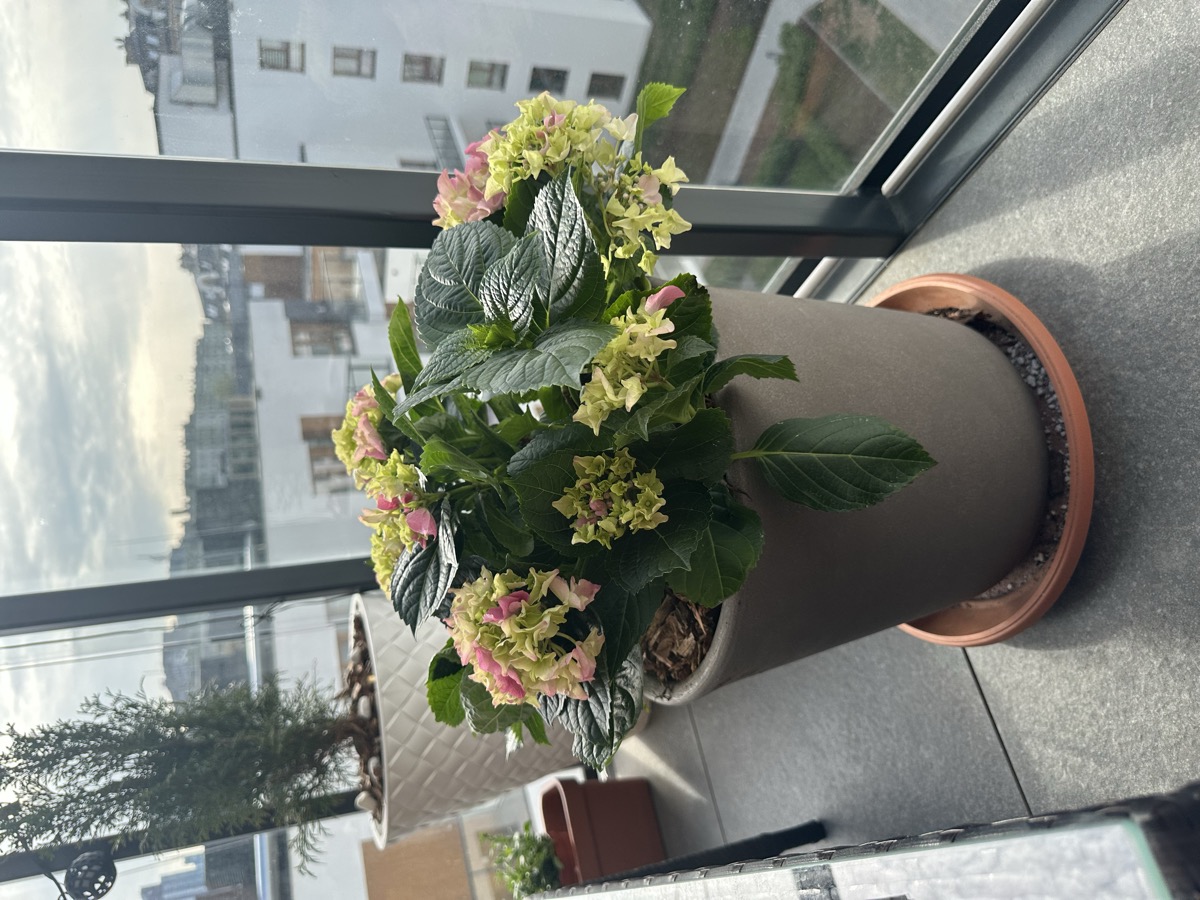
And here's the real-world parallel: while I was building Rouge — an exotic, intelligent, armored parrot from the tropical islands of Piratea — I was standing on my balcony surrounded by hydrangeas in pink and green, a new Bird of Paradise stretching its broad leaves toward the sky, and the petunias from yesterday still settling into their soil. Real exotic life while creating fictional exotic life.
The creative brain does this: it pulls from what's around you, even when you don't notice.
The Three-Tool Visual Pipeline
This is where Day Two became different from Day One.
Yesterday was about writing — narrative, profile, origin story. All text.
Today I added visuals. And the pipeline that emerged is something I want to document because it's genuinely new.
Step 1 — ChatGPT (voice): I describe the character out loud. Personality, background, combat abilities, relationship to Amaran. ChatGPT helps me refine the concept and structure the backstory.
Step 2 — Claude Code (canonical memory): I bring the concept to Claude Code, which writes the full character profile, validates it against 40 months of existing worldbuilding, and generates a detailed image prompt — specifying every visual detail (blonde braid, green eye, eye patch, leather coat, dwarven sword, Rouge on shoulder, port dock at golden hour).
Step 3 — Nanobanana (image generation): I paste the prompt into Nanobanana. It generates the portrait. Then I ask for a turnaround sheet (4-angle reference: front, left, back, right). Both images come back matching the written description almost exactly.
Result: within the same session, the character goes from concept → profile → portrait → turnaround sheet → deployed on the live website with a full character page.
That pipeline didn't exist two days ago. It emerged from the work itself.
What Two Days Produced
The Bird of Paradise and the Parrot
There's a moment I want to preserve.
I was standing on the balcony, positioning my new Bird of Paradise plant — a tall, dramatic tropical plant with broad leaves that catch the wind — when I realized what I was doing in the fictional world at exactly the same time.
I was designing an exotic bird companion for a pirate character.
A real exotic plant in my hands. A fictional exotic bird on my screen.
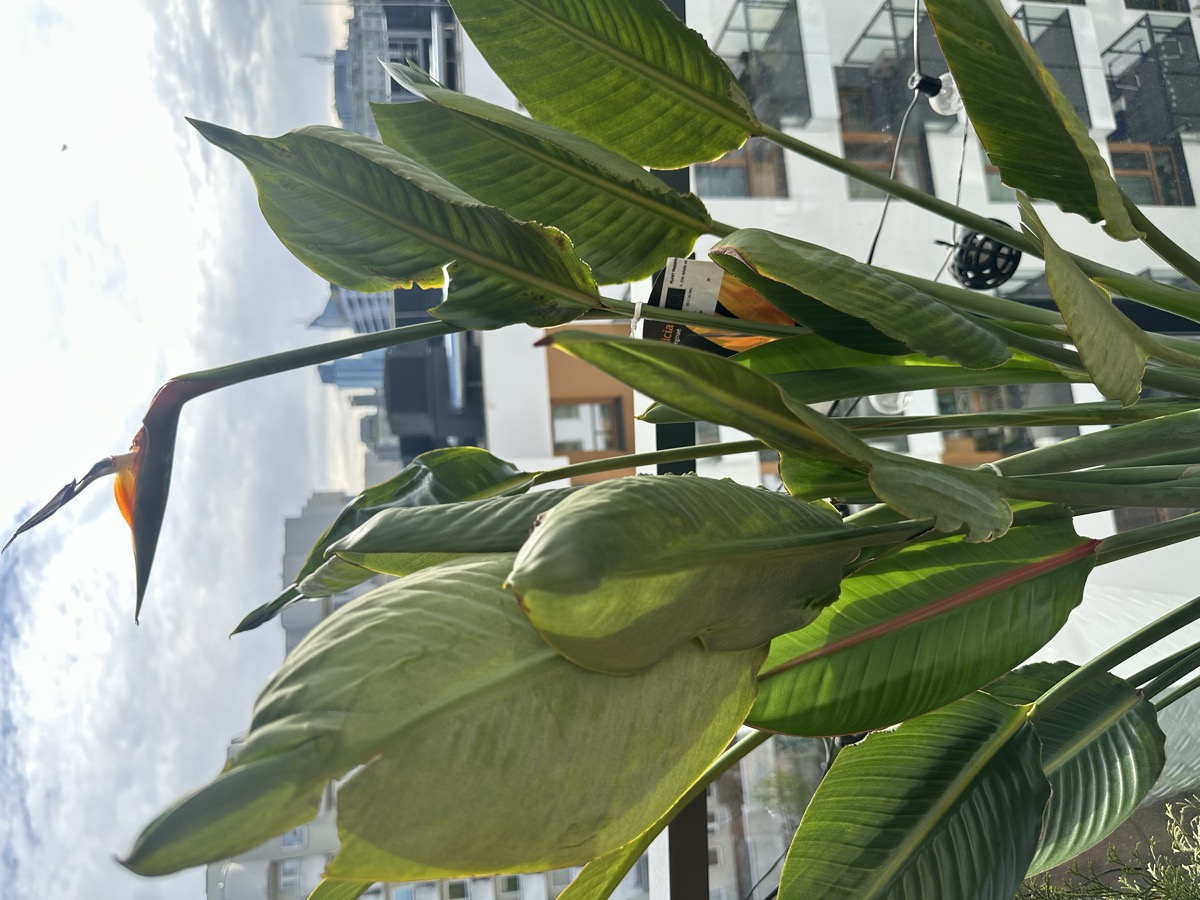
The creative brain doesn't separate "real life" from "creative work." It pulls from everything. The petunias from Day One became part of Amaran's story. The Bird of Paradise from Day Two sits next to the screen where Rouge was born.
I don't think this is a coincidence. I think this is how creativity actually works: you surround yourself with life — plants, soil, sunlight, coffee — and the ideas that emerge carry that aliveness into the fictional world.
Amaran feels warm because I was standing in sunlight when I created him.
Izabelle feels free because I was breathing fresh air on the balcony when I built her.
Rouge screams because — well, because parrots scream. Some things are just true in every world.
What I Learned About AI and Characters
Two days. Two characters. One insight:
AI is excellent at building the world around a character. The character itself comes from you.
ChatGPT helped me structure Izabelle's backstory, her family's dual identity between Piratea and Port of Sealune, and the political dynamics of why a pirate smuggler would be near Blood Moon Bastion. That's worldbuilding scaffolding.
Claude Code made sure everything fit — that the pirate routes connected to the right ports, that the dwarven sword from Stoneheart was consistent with existing lore, that the Nocthyris-pirate interaction made sense within the continent's political landscape.
Nanobanana turned words into a face. Blonde braid, green eye, eye patch, flame-sword, Rouge on her shoulder at golden hour on the docks.
But the decision that Izabelle's defining trait is curiosity — that she helps Amaran not out of heroism but because she'd never met a Nocthyris before and wanted to see what happened next — that came from me. Sitting on the balcony. Thinking about what kind of person runs toward the unknown instead of away from it.
That's the part AI can't do. And it's the part that makes the character real.
Tomorrow
The world is at 71% documented. Three continents complete. Seventeen characters on the website. Two new people who didn't exist three days ago now have names, faces, and stories.
The balcony has petunias, hydrangeas, and a Bird of Paradise.
The saga has a Nocthyris scholar, a pirate smuggler, and a parrot that might be smarter than both of them.
And the story keeps growing — the way plants grow. Not because someone forces them. Because the conditions are right.
Soil. Light. Water. Time.
And sometimes, an AI holding the threads while you dig in the dirt.
The Ethereal Web is a tetralogy by George M. J. Zak. Tome I — Thomas the Azure Light — is in final preparation for release. Follow the journey at theetherealweb.com.